Christian Heilmann

Author Archive

Speaking out – public speaking made easy (for women) was an amazing success!

Thursday, February 11th, 2010

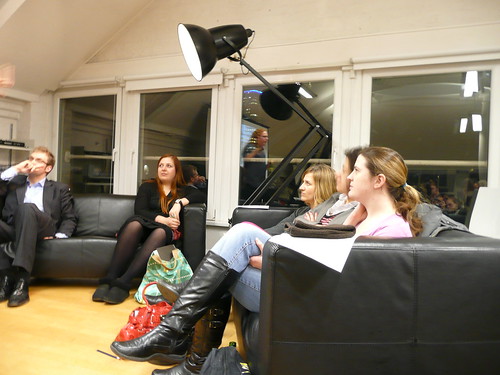
Yesterday night was the first Speaking out – public speaking made easy event in London and I was lucky enough to be one of the speakers. Speaking Out was the idea of my friend Laura North who hates public speaking and has been pestering me for a while for private tutoring on the matter. Instead, I told her we should organise a bigger event and this was it.
Speaking Out - Public speaking made easy by  you.

With help from Imagination and the Soho location of Sense Worldwide we successfully pulled off the first event of this kind.

Our not-too-hidden agenda was that we encourage more women to get out there and do more public speaking – be it in a meeting room or at conferences in front of hundreds of people.

The event is open to all, but women are especially encouraged to attend and subjects include speaking in public from a woman’s perspective.
Speakers include Katie Streten, Head of Digital Strategy at design agency Imagination, Christian Heilmann from Yahoo!, and Dave Bell from Merrill Lynch, who has been helping young women in Tower Hamlets make public presentations. All the speakers share the same aim of helping participants to communicate in a more relaxed and informal way.

On the day about 45 attendees (5 of which were men) got up the 4(!) flights of stairs to see what this is all about.

The introduction

The first surprise was that Katie made Laura do the introduction talk and thus put the money where her mouth is and take the plunge into her first public speaking appearance (and if you wonder, she mastered it brilliantly).

Dave Bell: Focus on presentation styles & contexts
Speaking Out - Public speaking made easy by  you.

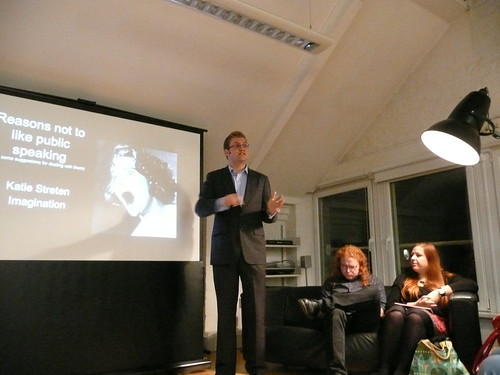
Right after this was Dave Bell who talked about dealing with public speaking in smaller groups, boardrooms and in pitches.

Dave’s main conclusions were:

  • Connecting with your audience is vital
  • Preparation is the key to being relaxed
  • Be selective with your material – think big picture!
  • Your style will develop over time and comes with practice
  • Presentations are performances – sometimes they go better than others.
  • And please remember: Everyone gets nervous – you aren’t the only one!

Katie Streten: Reasons not to like public speaking and some suggestions for dealing with them
Speaking Out - Public speaking made easy by  you.

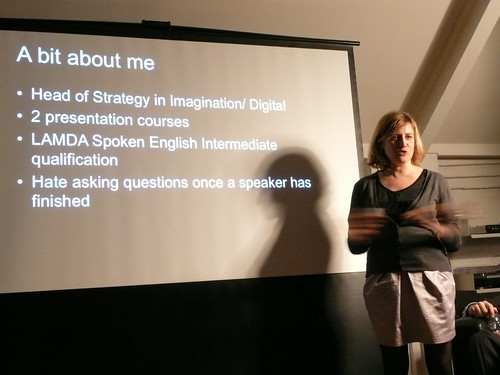
Katie Streten delivered a very engaging talk with a much better focus on the women’s perspective to public speaking than Dave or me (strange, that). She listed a bunch of reasons why people are afraid of public speaking and gave tips how to work around them. The reasons Katie managed to debunk during her talk were:

  • No one will be interested in what I’ve got to say
  • I will start speaking and go completely blank
  • I’m afraid that everyone will find out that I’m a fraud
  • I will look out over the crowd, see their faces and go blank
  • I will lose my place and just stall!
  • I will ask something that everyone else understands. I will look like a complete idiot.
  • It feels artificial. It should feel like a conversation, I hate the awkward feeling.

Katie’s slides are below and the audio recording will be available soon and I encourage you to check them out – there is some very good detail in there and I loved the way she kept it personal by introducing the people she got the above reasons from instead of quoting them as de facto truths.

After loosening up the crowd with free drinks and food, Laura thought it safe to let them hear what I had to say.

Christian Heilmann – How to inspire as a speaker
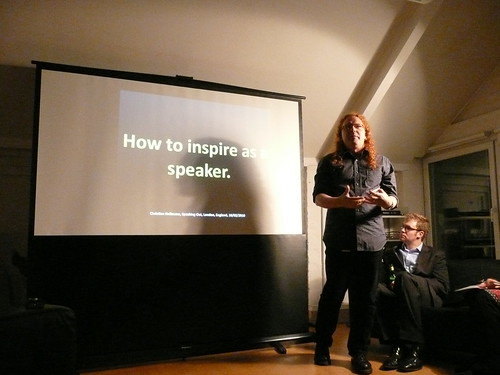
Speaking Out - Public speaking made easy by  you.

My talk was all about finding peace with yourself about doing a public speech. There is a lot of information out there about being a great public speaker but most of it is hokum and no matter how trained and well dressed you are – in the end it is you on stage. If you are not happy with being the speaker or if you are forced to be someone else or talk about things you don’t believe in you will do a terrible job. If you are yourself – with all your flaws and problems – then you will be believable and go off stage with a smile on your face.

Here are the slides of my talk on SlideShare synced with the audio:

I also did an audio recording of the whole thing:

Photos

There are some photos on Flickr:

What now?

This was a great little get-together and I hope we managed to relax some of the people who came. I think we should do this much more often – maybe next time do some PowerPoint Karaoke, lightning talks and only one talk one a more detailed sub-topic. I am very happy that we ran this event and can only hope that there will be more of those. Thanks to everyone involved and thanks for coming!

Update: Suw Charman-Anderson has taken some very detailed notes of the event, cheers Suw!

TTMMHTM: Scuba attacks in Norway,safer internet, mouse tracking and SMS API

Wednesday, February 10th, 2010

Things that made me happy this morning:

Rotating maps with CSS3 and jQuery

Tuesday, February 9th, 2010

One thing that annoys the heck out of me with maps you see on a screen is that you can’t rotate them. When I look at a real map I constantly turn it around so that I face in the right direction. Google maps lately added this feature in the hybrid and satellite maps but I wanted to do that with the simple maps and also other map providers.

The solution was CSS3. With the rotation transformations you can arbitarily turn elements. Of course this differs again from browser to browser which is why it made sense to me to find a library plugin that does that. Zachary Johnson build one of those and using this together with the Google Maps API it was pretty easy to build a rotating map:

Rotating a map with CSS3 and jQuery by  you.

The code itself is very easy – thanks to the transformation work already done in Zach’s code:

google.load("maps", "2.x");
   function initialize() {
     var mapcontainer = $('#mapcontainer');
     var mapdiv = $('#map');
     var geocoder = new GClientGeocoder();
     var map = new google.maps.Map2(mapdiv);
     map.addControl(new GSmallMapControl());
     map.addControl(new GMapTypeControl());
     map.setCenter(new google.maps.LatLng(37.4419, -122.1419), 13);
     mapcontainer.after('<div id="buttons">'+
                        '<form id="f"><label for="loc">Location:</label>'+
                        '<input type="text" id="loc">'+
                        '<input type="submit" value="go"></form>'+
                        '<p>Press R and L to rotate map, = to reset.</p>'+
                        '<p>Use cursor keys to move.</p>'+
                        '<p>Zoom with + and -.</p>'+
                        '</div>');
     mapcontainer.attr('tabIndex','-1');
     mapcontainer.focus();
     $('#f').submit(function(event){
       var value = $('#loc').attr('value');
       if (geocoder) {
          geocoder.getLatLng(
            value,
            function(point) {
              if (!point) {
                alert(value + " not found");
              } else {
                map.setCenter(point, 13);
                var marker = new GMarker(point);
                map.addOverlay(marker);
                mapcontainer.focus();
              }
            }
          );
        }
       return false;
     });
     mapcontainer.keydown(function(event){
       switch(event.keyCode){
         case 82: mapdiv.animate({rotate: '+=5deg'}, 0); break;
         case 76: mapdiv.animate({rotate: '-=5deg'}, 0); break;
         case 40: map.panDirection(0,-1); break;
         case 38: map.panDirection(0,1); break;
         case 39: map.panDirection(-1,0); break;
         case 37: map.panDirection(1,0); break;
         case 107: map.setZoom(map.getZoom()+1); break;
         case 109: map.setZoom(map.getZoom()-1); break;
         case 61: mapdiv.animate({rotate: '0'}, 0); break;
       }
     });
   }
   google.setOnLoadCallback(initialize);

Of course I was not the first with this. The StreetView Fun demo by Lim Chee Aun (@cheeaun) has a similar implementation (click “maps” in the demo to see it):

StreetView Fun by  you.

Things to fix

  • Map navigation: as you might have already experienced, dragging the map is becoming very confusing. This cannot really be solved as it would require Google Maps to know the rotation. Right now I am using the panDirection method to move the map with the cursor keys – a cleaner way would be to use PanTo and really calculate the next place to pan to taking into consideration the angle of the map. Any volunteers?
  • I am quite sure I am violating Google’s terms and conditions with this as I am cropping off the copyright.I found a way to display the copyright and Google branding:

GEvent.addListener(map, "tilesloaded", function() {
 var logo = $('#logocontrol');
 logo.attr('style','');
 var copyright = $('#map div[dir=ltr]');
 copyright.attr('style','');
 $('#mapinfo').append(logo);
 $('#mapinfo').append(copyright);
});

Explaining what YQL is to non-technical people

Monday, February 8th, 2010

A friend of mine was asked to produce some videos and screencasts to explain YQL to non-technical people and asked me to give her a definition. Here’s what I came up with:

What is YQL and what is it good for ?

The Internet as we see it (web sites, games, videos) is only a shop window to the thing that really drives it: data. All the things you see are based on information one provider offers another provider. Even you are a data provider – if you comment on a video on YouTube or you add a person to a photo on Facebook you create a data set. All this data is made available behind the scenes to different people – this could be developers in the same company or partners or – for example in the case of the Yahoo Developer Network – other developers.

The information comes in different formats. For example the photos on http://www.flickr.com/photos/tags/cat are available in “JSON” format at http://api.flickr.com/services/feeds/photos_public.gne?tags=cat&lang=en-us&format=json.

To you this might look like nothing much but developers have a lot of fun with this information. It gets especially interesting when you mix and match different information sources to get a new picture. You can for example map the news onto the world to give them geographical context.

All of this sharing of information follows certain conventions much like normal conversation does. You need to ask the right question to the right person in the right format to get the correct information back. In the case of data on the Internet this gets even more confusing as all the data providers speak different languages and give you information back in formats that you might not understand. Imagine going shopping for clothes and each shop assistant speaks a different language and each shop has different size charts for the same type of clothing.

In normal communication amongst people with different languages we have translators – sometimes even simultaneous ones. And this is what YQL is. YQL is a simple to understand language to allow you to get information from any source on the web and gives it back to you in a language you understand. Every resource on the web can get a simple name and developers can call this name up to get to the data it offers. So for example getting photos from flickr becomes

select * from flickr.photos.search where text='cat'

Translating a text to French becomes

select * from google.translate where q='hubcap' and target='fr'

You can also mix and match different sources, for example you can get the latest headlines from yahoo’s top stories and translate them to French:

select * from google.translate where target='fr' and q in (
select title from rss where url='http://rss.news.yahoo.com/rss/topstories'
)

This language is very close to another language called SQL which is the standard for accessing information in databases. So, in essence, YQL turns the internet into a massive database where developers can access information and remix it to make it easier for end users to see relationships between different pieces of information or even develop interfaces that make it possible for users to get access to the information.

For example this great lecture on YouTube can be listened to by blind users using the EasyYouTube interface that uses YQL to get to the information of the video.

YQL can be accessed on a pure programmatic level but the easiest way to get a glimpse of its translation and access powers is to use the console.

YQL is a great communicator – it allows you to speak to all kind of data sources in the right language, ask the right questions for you, find the right internal phone numbers to get to even other resources needed to get to a certain piece of information and give back to you only what you asked for and not a whole mass of information you will never need. And it is amazingly fast in doing so as Yahoo built it to deal with exactly the same problem of data communication inside the company.

Giving technology to the world – a talk about writing good code examples

Friday, February 5th, 2010

One of the things I love about my company is that you are perfectly allowed in Yahoo to give “Fire and Brimstone” talks to rally your colleagues. It is a very open company and if you can back up criticism with proof and offer solutions people are happy to listen to you.

Last Thursday I took the opportunity of being in the Silicon Valley to give a talk about giving technology to the world, pointing out mistakes we made in explaining our services and APIs, what works well and how some competitors do a great job at explaining complex technology in an easy to understand fashion.

It was a great opportunity to explain the concepts of developer evangelism to an internal audience who hadn’t yet read anything about the matter of seeing developers as an audience.

Check the slides on SlideShare and the audio on archive.org:

Listen to the Audio of the talk on archive.org:

Do you know any great API sandboxes and documentation? I’d be happy to have more positive examples!