Christian Heilmann

You are currently browsing the archives for the General category.

Archive for the ‘General’ Category

AEGIS – Sun sponsors open source solutions tailored for accessibility

Monday, October 20th, 2008

Just got this via the webaim mailing list:

I am very pleased to share with you news about the AEGIS project, a 12.6m investment in accessibility, with the vast majority of it focused on open source solutions.
Rather than repeat here all that I have written about AEGIS already, I will instead invite you to read about it in my blog: http://blogs.sun.com/korn/ or check out the AEGIS website at: http://www.aegis-project.eu/. I have worked in the field of accessibility for nearly 17 years, and on open source accessibility almost a dozen of those years. In that time, open source accessibility has become a deep and abiding passion.
I’m very proud that the techniques we have pioneered in the open source community have since been adopted by Apple with the Macintosh & VoiceOver, and are being adopted by Microsoft with UI Automation. These same techniques are enshrined in the report a 42 member committee delivered to the U.S. Access Board earlier this year (and which at this very moment being reviewed by them as they work on their refresh of the Section 508 accessibility standard). And these techniques are at the core of the AEGIS project. With AEGIS, over the next 3.5 years we will attempt to bring programmatic accessibility more fully to the web, and to the mobile world. With AEGIS we will also address a number of issues that still remain inaccessibility on the open desktop. And while we’re at it, we will bring a bunch of new and talented people into the open source accessibility community (you should start seeing them showing up on our mailing lists and wikis in the coming months). We will also fund a number of the experts who have already made tremendous open source accessibility contributions – to enable to them to continue and to do even more. I’m sure they will shortly make their voices heard on these lists and in the blogosphere. And we will explicitly fund a number of European disability organizations. These organizations and many dozens of their members will be providing their expert input on our work, and thoughtfully evaluating our prototypes, and perhaps adopting the solutions we come up with because they do a great job of meeting their needs. Oh, and we’ll also write a bunch of open source accessibility code.
This Sunday the 19th of October marks the 8th anniversary of the GNOME Accessibility Project. AEGIS helps bring a fantastic 8th year to a
close, and also serves to inaugurate the next 3.5 years!
Regards,
Peter Korn
Accessibility Architect & Principal Engineer,
Sun Microsystems, Inc.

How cool is this! It is great to see that the open source world is going full steam with accessibility and now we need to make sure that what they do reaches the people that need what they built and doesn’t get lost in IT department red tape.

I’ll get in contact with Peter and see how we can collaborate
Those crazy swedes… Geek meet in Stockholm in December

Thursday, October 16th, 2008

Both Robert Nyman and Isac Lagerblad just pinged, tweeted and mailed me about the Geek meet in Stockholm in December that I agreed to talk at.

It seems that within an hour all seats were sold out, so I am about to put on my warm boots and mittens and think hard about really writing the presentations I promised:

Shifting your site into the next gear

In this session Chris is showing how you can speed up your web sites, what issues to avoid, what of the information out there is really applicable to you and what little things you can change to get a great impact. As examples we’ll cover lazy loading and progressive enhancement that delivers faster and makes end users happy.

Playing with the web

In this session Chris is going to show tools and ideas that allow you to quickly prototype changes in web sites, get to information that is not offered publicly and re-hash that information into something useful. As examples we’ll be looking at creating a currency converter, translating and detecting language and show how we can change and distribute the change of a web site without touching the server.

Looking forward to coming back to Sweden in December!

onPoverty = action()

Wednesday, October 15th, 2008

Today is Blog action day and bloggers around the globe are asked to write about poverty. Well, as the invitation to the day already says, there are no easy solutions for a problem like this, but here are some things that have been bothering me for a while when it comes to thinking about poverty.

Poverty is not that far away from us than we think

When it comes to world poverty we always get the mass media pictures of children starving and people not having any shelter and it makes us feel uneasy as it is something we just don’t want to consider when we have to decide wether to buy the new macbook or get a good home theatre.

Fact is though that poverty is not that far from us in our own surroundings. Part of why I left my old job and moved to where I am now is that we started doing IT projects for mortgage and debt consolidation companies. Despite the IT work being boring I also felt dirty every single day I had to deal with this.

Emails came in of people asking for debt consolidation (as the company was too stingy to set up a database but wanted an unencrypted form mailer instead) and they ranged from “I bought too many things” to “my wife has cancer and the operation and medication bills are piling up”. What really got me though was that for the system all these people were numbers and pre-defined decision trees – how you got into debt was of no consequence.

A friend of mine just last week had to rustle up 8000 Euros for her father’s operation. The father lives in southern Europe and it seems there is no way to get a proper hospital service without bribing the nurses and doctors as they get underpaid, too. These are expenses that come out of the blue and you can’t prepare for them. What would you do? Hope that dad is OK even with bad service? (I am not judging here, I am just reporting what has been said).

Try to disrupt the cycle of consumption as often as possible

One thing that really ticks me off is that Aldous Huxley’s Brave New World is becoming more and more reality. One thing described in this amazing book is that it is a sin to repair things – buy new ones instead.

If you look into our market now then you come to realize that this is where we already are. Trying to get a camera or a personal media player repaired is more expensive than getting the newer version. I remember that when I bought something as a teenager it was an investment – you could re-sell the Vinyl, walkman, CDs, cool jacket or shoes to your mates when you wanted. Nowadays this is not the case any longer. Yes, you can put things on ebay and battle the myriads of power sellers with automated bidding or – and I find myself doing this increasingly – give the things you don’t want any longer to a charity shop.

With the credit crunch and all coming I am sure there’ll be a renaissance of shops that repair things for you. I am lucky to live in a part of London that still has those and make sure to have them have a go at repairing things that broke before replacing them. We will have to do that sooner or later anyways.

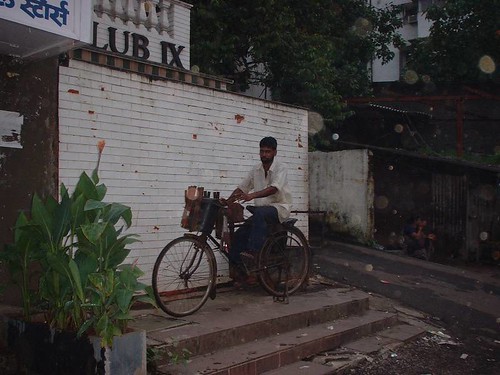
One of the coolest things I’ve seen in this regard was when I was in India in 2004 and saw this man:

palihill knifemaker

He cycles from village to village and sharpens and repairs people’s knifes and kitchen scissors with this modified bicycle. This is entrepreneurship, not showing another cool app to calculate your carbon footprint and ask for $$$ of VC funding.

Stop believing the hype about money

One last thing I am just not getting is that everybody in the west is wealthy by living off borrowed money. I’ve never had a loan and I never had an overdraft on my account – I just can’t do it. I was brought up by parents who scratch the magnetic stripe on their bank cards as they don’t trust computers or don’t want to be able to spend money they don’t have. Both grew up during the second world war and learnt the hard way how to get on with what they have.

When I wanted to have some superfluous stuff as a teenager or kid I was asked to do some chores and later on my dad got me little jobs (bricklaying, packing in a chainsaw factory, sorting out recycleable materials from people’s rubbish) to make the money myself to be able to afford them. I hated them for this – now I am very happy that they brought me up this way.

Money does not grow on trees, and by now we are so far into a world of virtual richness that the figures we play with are not even backed up any longer by real valuables – gold for example. The biggest losers of the whole credit crunch and recession will be the people who helped us get to where we are now – pensioners.

So what’s my conclusion?

I don’t have any solution for poverty – otherwise I’d be much more famous and in politics (or assassinated as people hate solutions for problems that actually can be turned into a profit if you have no scruples). All I want to say is that in order to think about poverty it is a great idea to see how you live, what you spend money on and especially keep in contact with people who got you where you are now. Of course we need to battle world poverty, but first and foremost it is time to make sure that people we owe a lot to should not have to live below the standard they deserve because some other people love to play with numbers on the stock market. Giving money to the third world is a nice thing to do and gives us a warm, fuzzy feeling, but changing our immediate surrounding or really getting into helping on the ground has a much larger impact.

Codepo8 says: Find Me

Monday, October 13th, 2008

Every time I go to a conference and meet with Matt Biddulph of Dopplr I feel a little pang of regret that I yet had forgotten to update my dopplr profile again. I know it is easy to do this with FireEagle (even with the awesome “my location is” REST URL (f.e. http://fireeagle.yahoo.net/my/location/is/51.4992,-0.135505) but I somehow didn’t quite make the jump to a fully mobile life yet. I guess I will have to ditch the £80 HTC Touch I got in Hong Kong and get myself a nice and more GPS enabled phone. Any ideas? I guess Alfie Dennen would be the man to help.

Webmaster Jam Session hack – quickly fixing a web site with YUI grids

Saturday, October 4th, 2008

Last weekend I went to Atlanta, Georgia to speak at the Webmaster Jam Session or short WJS organized by Coffeecup software. I’ve written a detailed report on the event on the YDN blog and in short it was fantastic.

One of the things I did at the event is sit in on one of the Website Smackdown sessions, which are expert reviews of web sites people in the audience submitted. One of the sites was the following:

The original site

What shocked me about it was that it is fairly new, but still uses tables for layout. When I investigated I heard that the reason is simply lack of resources to build web sites in a different manner. This is sad, as nowadays we have resources to build upon readily available on the web that we couldn’t even dream of when I started developing. To prove the point that you can re-do a small info site like this one using semantic markup and CSS without even knowing much about it, I used the YUI grids and created the following in roughly 15 minutes:

YUI redesign site

You can download the web site demo files and play with them yourself.

I’d be happy to write more, in-depth articles about this kind of structure and redesign if there is interest. The only question I have about it is where to publish them? People that would benefit from these are not likely to read the blogs and magazines I write for. Is there a government web standards publication somewhere?