Christian Heilmann

Author Archive

Redirecting GitHub Pages

Tuesday, August 3rd, 2021

Monopoly card redirection to jail

Today I finished moving the Edge Tools for VS Code extension documentation to its official space in the Microsoft docs. That meant I needed to redirect the documentation I hosted with GitHub pages in a docs folder/branch of the repository.

There are plugins available for that, but I didn’t want to install any extra features on the repository, so I chose a simpler approach.

You can define HTML templates for your GitHub pages in a folder called _layouts and connect them using the Markdown frontmatter. So if you create a file called test.md you can define a template called forward. You can also add a target to redirect to, in this case https://example.com

test.md:

---
layout: forward
target: https://example.com
---
... rest of your markdown ...

Your forward.html template in the _layouts folder can use a meta redirect to the target. In its most basic form this can be:

forward.html:

<html lang="en">
<head>
    <meta charset="utf-8"/>
    <meta http-equiv="refresh" content="0;url={{ page.target }}"/>
    <link rel="canonical" href="{{ page.target }}"/>
    <title>Redirecting</title>
</head>
<body>
    <p>Document has moved, if you aren't automatically redirected 
    <a href="{{ page.target }}">go here</a>.</p>
</body>
</html>

That means that if someone goes to the test document in your GitHub pages, they will get redirected to example.com

You can see this in action in this GitHub demo repo I quickly put together. I’ve added quite a few more options to redirect, such as definition of the time and displaying different titles and text. You can read it all and try out the demos in the README.

Using console.log() debugging in Visual Studio Code

Friday, July 30th, 2021

Using the new in-built JavaScript debugger in Visual Studio code you can use the browser developer tools Console right inside the editor.

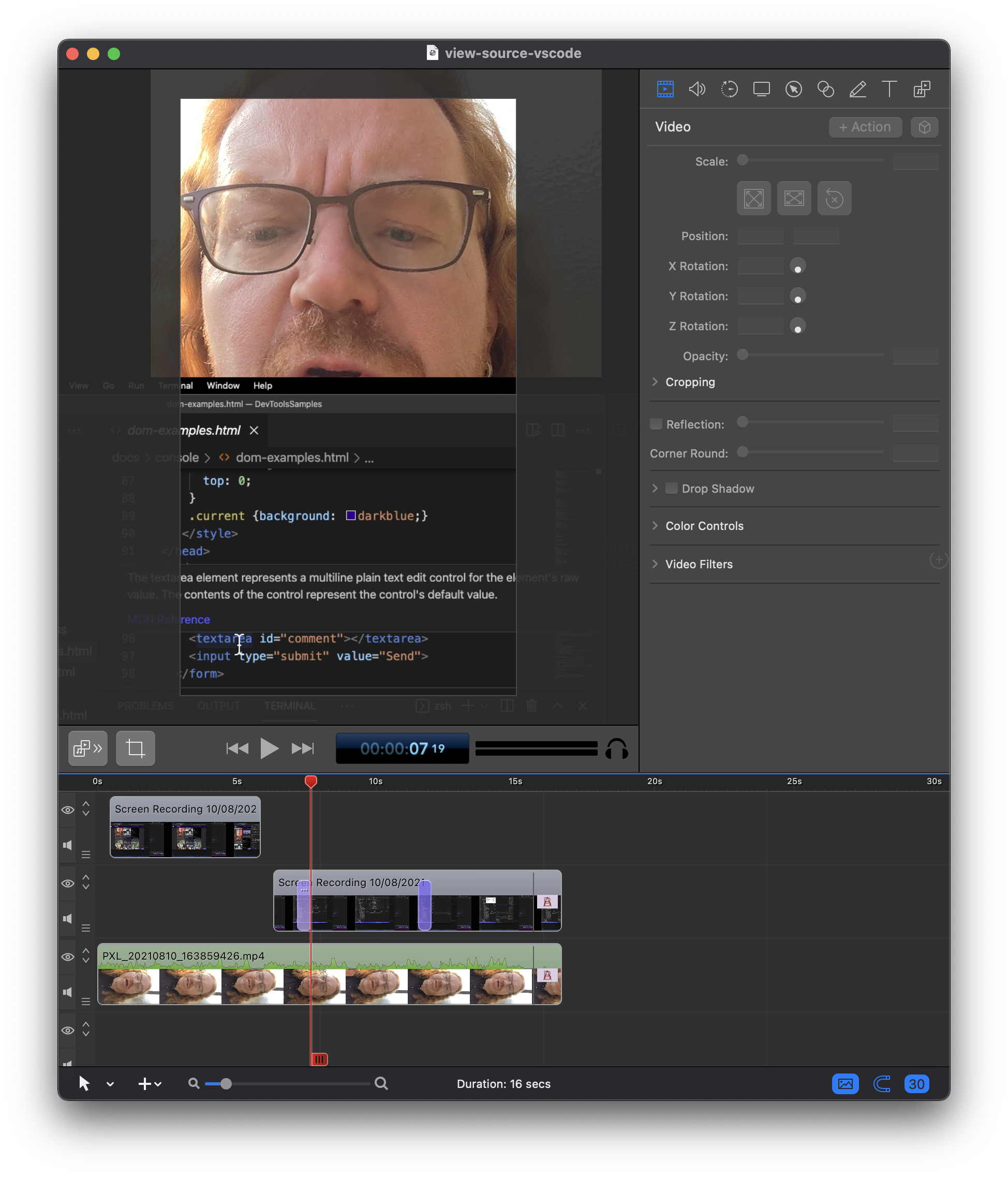
I just published a “TikTok” style video on the official Visual Studio Code channel explaining this and – after lots of criticism for the quality of the video (lads, this is on purpose!) – people had more questions, so here goes.

In the video I use a project I have open with a launch.json file already defined, which means it opens the correct URL for you when you start debugging. You can, however, also do that by hand. And it even works without a local server. So, let’s do this.

Step 1: Create a folder and call it consoledebug
Step 2: Start Visual Studio Code, choose “open” – select that folder

New instance of Visual Studio Code with "Open Folder" selected

Step 3: Select New File, call it index.html
Step 4: Add some HTML/JS and save it

HTML Example for console debugging

Step 5: Select the “Run and Debug” icon and press the “Run and Debug” button

Selecting the Run and Debug workflow

Visual Studio Code now opens a browser window for you and you can see the console.log message from the demo code in the Debug Console.

Console messages in the Debug Console of Visual Studio Code

You can use the Debug Console to do anything you normally do in the Console of the browser tools. You also have access to all the convenience methods, like $ for document.querySelector. Try it out by using $(‘body’) in the Debug Console. You get all the information about the body element of the current document.

Accessing the document body from the debug console

This is a full REPL console, and you can just type in any JavaScript to try out, for example 2+3 or ‘log’.repeat(20)

Running JavaScript in the Debug Console

You also have full access to the Window object and the DOM of the current page, for example, to change the background colour of the document, you can use $(‘h1’).style.background = ‘peachpuff’ (and not what I did first in the screenshot).

Changing CSS from Console

For all the features of Console, check the documentation.

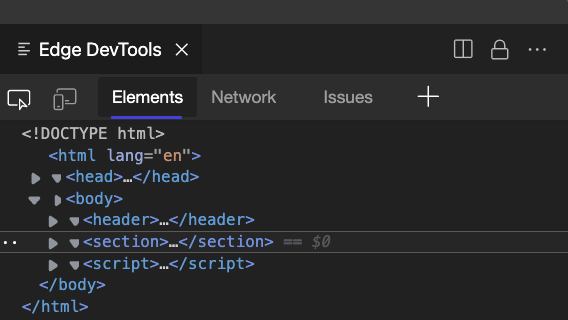
If you use Edge as your debugging browser, you also get something extra. Hitting the Inspect button on the debug bar will open the Developer Tools Elements and Network right inside your editor.

Developer Tools in VS Code

But more on that later.

Accessibility WTF: Voiceover on Mac announcing a list tree as a table?

Wednesday, July 28th, 2021

I’m currently investigating a strange bug we got reported with the Edge Developer Tools. Voiceover on MacOS announces the DOM tree as a table and tells you how to navigate it – which then doesn’t work.

Voiceover announcing a list marked up as an ARIA tree as a table.

The reason is that the markup isn’t a table. The DOM tree is, well, a tree, built with OL, LI and ARIA roles. But Voiceover doesn’t recognise that. Narrator on Windows and NVDA work.

Developer tools open on Developer Tools showing the right markup for an accessible tree

I thought at first that it is a problem related to the list-style:none voiceover issue but it even happens on an example without any styles and on the W3C demo of treeview .

Bare bones example of the HTML of Developer Tools with Voiceover announcing it wrong

W3C treeview demo announced as table in voiceover

Let’s hope this gets fixed soon, as for now, I am stumped as to work around this issue.

Update: As Tomas Caspers pointed out on Twitter, this might be caused by a weird old HTML demo in the ARIA spec using a table and lots of roles to explain the functionality.

Debugging JavaScript, DOM, CSS and accessing the browser console without leaving Visual Studio Code

Thursday, July 22nd, 2021

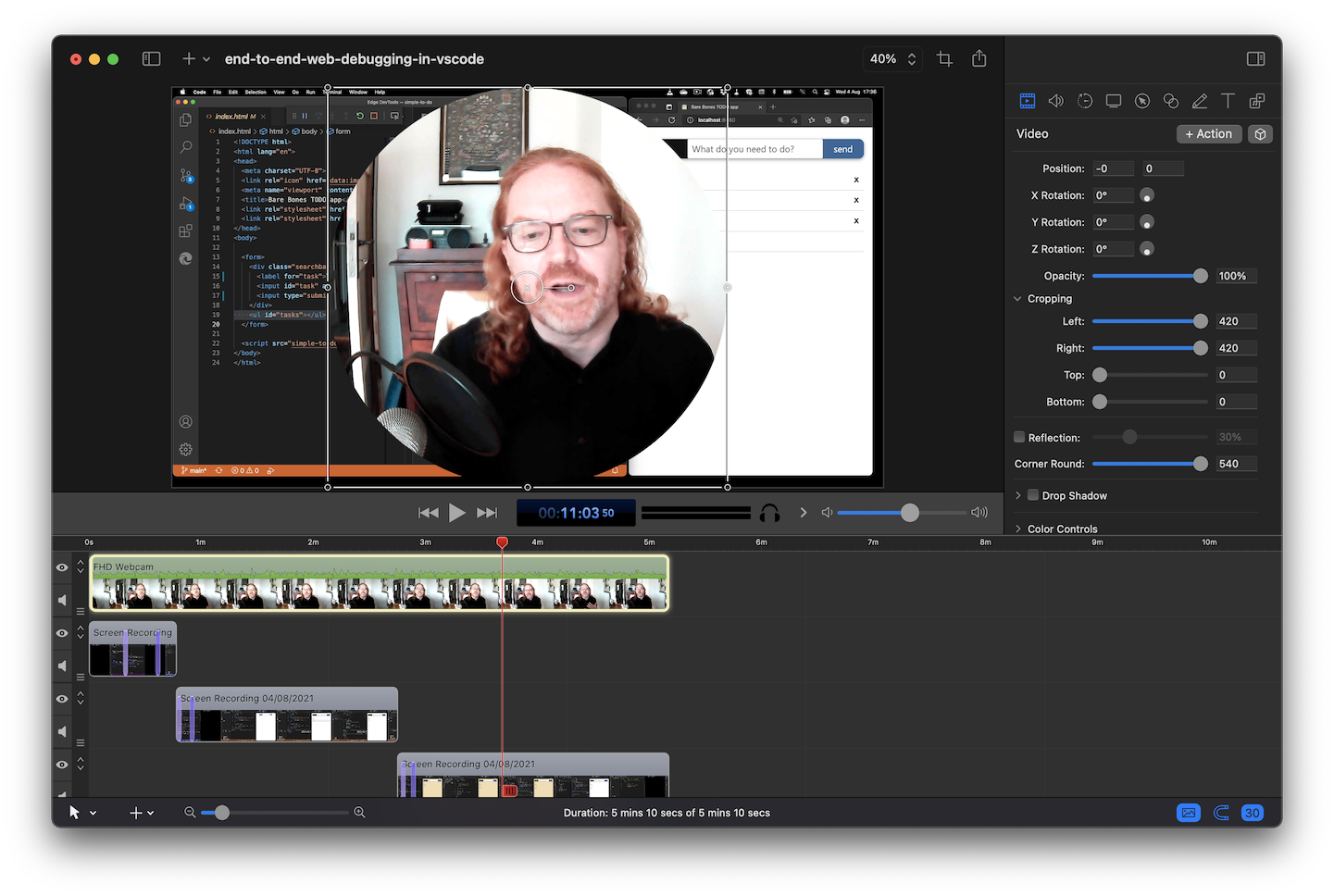
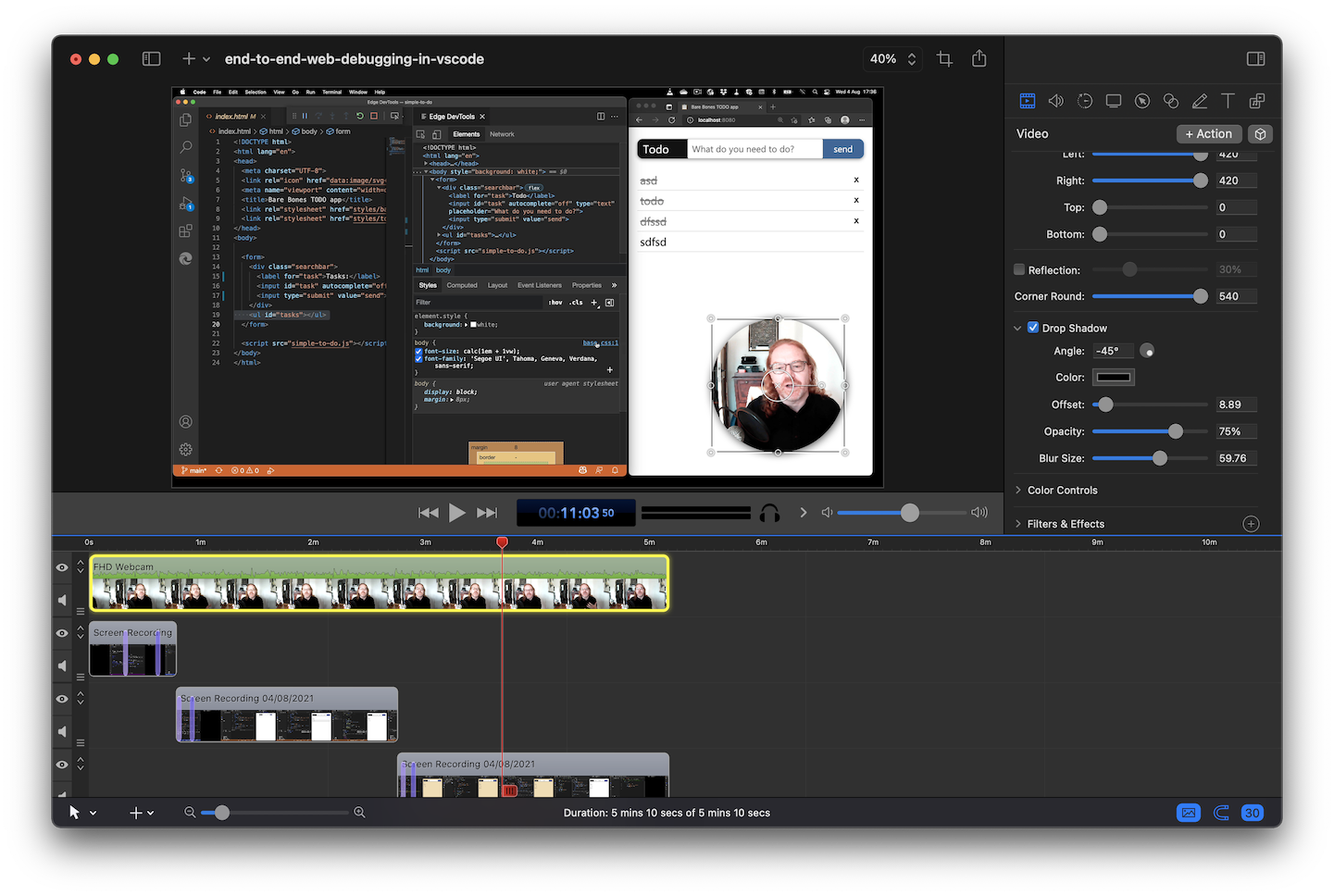
Now that Visual Studio Code has an in-built JavaScript debugger, it has become incredibly convenient to debug your project without leaving the editor. You can debug JavaScript, tweak CSS and the DOM and interact with the browser Console right inside VS Code. And you don’t need to know which extensions to install as the editor guides you along the way.

Under the hood, this uses the JS Debugger and the Edge Tools for VS Code extensions. Here’s what the flow looks like:

If you haven’t got the Edge Tools extension installed, VS Code will prompt you to do so the first time, as shown in this screencast:

In addition to breakpoint, DOM and CSS debugging, Visual Studio Code’s Debug Console now also is the same Console you normally get in the browser. You can access the window object of the browser instance and use all the Console Utilty Methods like `$` and `$$`.

To run the debugger automatically on your project, you need to create a `launch.json` file and define the debugger as the launch type. The Edge Tools extension can also do that automatically for you. If your application is not on `localhost:8080` you need to tweak the `url` parameter.

{
    "version": "0.2.0",
    "configurations": [
        {
            "type": "pwa-msedge",
            "request": "launch",
            "name": "Launch Edge against localhost",
            "url": "http://localhost:8080",
            "webRoot": "${workspaceFolder}"
        }
    ]
}

If you want to see this in action, you can download/fork the demo to-do app I used in the screencasts.

What do you think? Anything you’re still missing in that workflow? File an issue on GitHub and tell us about it!

The accessibility stalemate

Tuesday, July 20th, 2021

Scrabble board spelling publish

Over the course of my career I’ve seen a lot of excellent accessibility presentations and learned a lot. That’s because I worked in the accessibility space and went to specialist conferences. Web development conferences also have accessibility talks and their number is rising. But often these don’t go past the 101 stage or repeat things that should be obvious. Alas, many of these things aren’t obvious to the average designer/developer. The reason could be a thing I’m calling the accessibility stalemate.

What do I mean by that? A lot of excellent accessibility advice never gets distributed beyond the initial audience. The reason is that people love to call out any accessibility problems with the materials. There is a knee-jerk reaction I’ve seen over and over again. Calling a slide deck explaining how to make content accessible that isn’t fully accessible as “ironic” or “a bad example”. A lot of presenters don’t share their talks because of that. I saw many conferences not release any of the materials or videos as they couldn’t caption them or host them on a platform that allows for it.

It is tough to make things accessible. I’d even go as far as saying that you can never make things accessible to everyone. All you can do is make sure that the materials you publish can be altered to the needs of your users. At the least, provide information that describes things that are visible only – like alternative text for images. We understand that and when it comes to products in the wild, we’re forgiving if things aren’t perfect.

We are not as lenient when it comes to information materials of accessibility events. If they aren’t perfectly accessible, they’re seen as a disgrace. And that’s holding us back.

Many presentations complain about the lack of basic accessibility in products. On the surface, it seems to be valid criticism to call out when they aren’t in an “accessible format”. Or when they fail to provide alternatives for each image and video in them. Except, it is a cheap shot and feels like a distraction from the problems the materials talked about. “You don’t follow your own rules, so why should I?” is a cop-out of those who don’t want to think about a certain matter.

It reminds me of this classic piece by Jeffrey Zeldman that calls out people criticising articles for the platform they are published on. “Isn’t it ironic that I can’t read your article on mobile best practices on my mobile device” and similar smart remarks. No, it isn’t ironic, and it is also not that important.

What do we gain by ensuring that a presentation about how people use screen readers is accessible by a screen reader? Is that the audience? The one who already knows this information? Who do we serve with this? Or – let’s turn it around – who do we miss out on when we spend a lot of effort on it? Unless the talk is about creating accessible presentations and you show with your talk materials how to do it, it seems extra effort not serving the right audience.

How about we stopped with this and instead concentrate on getting accessibility information to those who need it in a format engaging to them?

Here are a few accessibility truths/prejudices to tackle:

  • Accessibility is scary – the best selling point for accessibility hasn’t been “making it work for everybody will create better products” but “you will be sued if your product isn’t accessible”. We’ve played that card for years – it works. However, it doesn’t result in accessible products, it results in compliant products. But it cemented accessibility as something people don’t strive for, but something they worry about instead.
  • Accessibility is boring – by telling people they must do invisible things to be compliant we didn’t make accessibility a “wow, I want this”. We made it a chore, a task to do before you can release. Accessibility isn’t boring. Just look at how we use our mobile phones. Most of the features that make them cool (geolocation, voice recognition, read aloud…) were originally created for assistive technology. And yet we worry about not spicing up our accessibility presentations with multimedia as it isn’t accessible to all.
  • Accessibility is complex – currently I work on developer tooling, and I try hard to make accessibility testing and creation of accessible interfaces easy. It isn’t though. The whole idea of the accessibility tree as an alternative representation of the document is confusing a lot of people. And while we have highly visual and intuitive tools for performance testing and CSS creation, the accessibility focused ones tend to be basic and bland. Right now, most of them are used by testers instead of developers/designers. That’s not enough.

We have a lot to gain by making accessibility, well, more accessible. We do not do that by blocking information from going out as it isn’t perfect when it comes to accessibility. We do cater to various audiences, and you catch hearts and minds by using a format that appeals to these audiences. Not the lowest common denominator.

So next time you feel like calling out a great video or presentation for lack of “accessible format” or captions, maybe do something about it instead. Write about the video or the presentation and publish your musings in a perfect, accessible format. Good luck.

Learn more: More about my approach to accessibility and how I ensure that our products have an accessibility built in from the get-go, in my Skillshare class Product Management: Tools for Improving Product Accessibility.