Christian Heilmann

You are currently browsing the archives for the General category.

Archive for the ‘General’ Category

Needs of the disabled spark inventions – why not in web design?

Wednesday, November 8th, 2006

I just created a presentation for a Tech Talk later on with the topic “Accessibility and You, a non-tech approach to web accessibility” and during the collection of material I realized that a lot of real world inventions were based on the needs of disabled people and are now benefitting everybody.

  • Thomas Edison and Alexander Graham Bell invented the loudspeaker and subsequently the telephone to help Edison overcome his hearing problems, now we all use loudspeakers (sometimes to turn us into someone who is hard-of-hearing)
  • Subtitling and captioning of movies and TV programmes helps deaf users, but also those who are not firm in a foreign language and still want to see the movies as they were intended (I learned a lot by watching Monty Python’s Flying Circus with subtitles)
  • Talking VCRs and universally accessible doors make it a lot easier for both people with disabilities and those without to use them.
  • The University of Manchester is working on some software to make mobile web surfing a lot easier by automatically stripping unnecessary content from web sites. The algorithms and logic of the software is based on research with blind users and screen readers.
  • IBM is working on an alert service for deaf people to get informed when there is a public announcement on stations and airports. When there is an announcement their mobile phones get a message or vibrate, which is something that any visitor could profit from (how many times did you have a delayed flight, went for a coffee and had to neck it because you felt uneasy about not seeing the notice board?)
  • The curb cut, those dips in sidewalks created for people using wheelchairs makes it easier for people with prams, cyclists and others, too.
  • OCR scanning was invented to allow a blind person to hear a text that was previously printed and became a massive success in data entry processes.

These are just some examples, and I’ll be happy to add more (comment please) were a disability became the spark that started a new invention.

However, when you look at any web design list or forum these days, all you hear is “I need to add skip links” or “I need to make this accessible” or “how can I make this work with screen readers?”. Where is the spark there? How come not many people see accessibility as a chance to improve a current product or use it as a test phase to give the product a trial by fire before considering it worthy of publication?

During a summit last month in Germany Markus Erle talked about accessibility testing as an incubator to make products more stable, mature and ready for the real world and not as a means to create a habitat for handicapped users.

This inclusive approach is not new, in fact Wendy Chisholm’s article Innovative Design Inspired by Accessibility on Digital Web covered it already in 2005, but I don’t see it being followed or getting as much time in the limelight as the old “so what do we have to do to accommodate disabled users”?

Thanks to Tomas Caspers and Mike Davies

[tags]Accessibility,Usability,Web Design,Design,Access[/tags]
Moved to media temple

Tuesday, November 7th, 2006

After almost four years my free hosting service finally didn’t work out any longer and I was annoyed about the outages and the other clients on the shared box annoyed about the traffic I caused.

So I bit the bullet and got myself a new server for all my sites. I looked around a bit, dropped some mails on thelist and with other bloggers and I decided to go for the grid server offer of media temple in the USA.

I dreaded the move, as over the years I have acccumulated a lot of data connected to 6 different domains. All the more I was very much surprised to see that I was able to get and connect a new domain, shift my data over and reconnect my old domains (onlinetools.org is still on the old server) to the gridserver within less than two hours!

The admin interface of the grid server allows you to define which domains to use, set up the mail servers and webmail interfaces and lets you define whether to use PHP4 or 5 on a per-domain basis.

You can add extra PHP components by altering an add-on to the php.ini and you have MySQLAdmin by default. Urchin is also included, but I haven’t set that up yet, and you have preconfigured WordPress, ZenCart and Drupal in case you want it. I tweaked this WordPress too much to go all fresh and new, but maybe I will at a later stage.

I now also have a proper spam filter and can play with Ruby, which is pre-installed, too. All in all, I am very happy so far and the price of $20 per month seems not to be too high for what your are getting.

[tags]Hosting,Webhosting,media temple,ruby,php,wordpress[/tags]

Explore flickr tags and photos with flickrdrillr

Friday, November 3rd, 2006

I played with JSON, event delegation and the APIs of flickr for the upcoming hack day and thought it’d be fun to explore flickr only by tags.

Using the YUI, I put a small example together that allows you to search for a tag, get all the other tags entered by flickr users and see the photos related to the current tag. You can then click the next tag, get the related tags for this one and so on and so forth.

Have a play and check out flickrdrillr now

[tags]flickr,photos,tags,folksonomy,animation,images,javascript,event delegation,dom,json[/tags]

Douglas Crockford does the DOM on Video

Wednesday, October 18th, 2006

I was lucky enough to get some good JavaScript trainings in the last months, one of which being Douglas Crockford explaining the DOM as an inconvenient API to work with.

While his slides have a splendid “Silent Movie” style to it (white text on black background), they tend to be a bit overwhelming when you don’t get his explanations alongside them. Well, <farnsworth>Good News, everyone!</farnsworth>: his sessions have now been made available as small half hour videos on the web.

Personally I learnt more in Douglas’ training sessions so far than in about 5 years of reading books and web content on the subject. This is really good material if you want to understand why working with the DOM can sometimes be a very tough job.

[tags]DOM,JavaScript,DOM Scripting,Douglas Crockford,training,video[/tags]

Opera backstage in London – a Viking night

Wednesday, October 18th, 2006

With the copious amount of free alcohol still in my body and this being somewhat of a celebration (the 350th post – yes, it is rather random, sue me), let me allow myself to talk of a night out in the West End (10 minutes from the office) with Opera playing host to bloggers and web developers showing off their new products and ideas.

Opera invited me to the backstage thing via onlinetools.org (of all places) and asked me to bring workmates along as they are interested in sharing their ideas and show what they are doing.

The crowd was the typical London mix and some unexpected faces: Yahoo peeps, BBC peeps, Clearleft from Brighton (Andy Budd, Richard Rutter, Jeremy Keith with his lovely wife), local bloggers and web developers and some less obvious people like Ian Lloyd and James Edwards.

Opera provided the good ingredients of any Webdev meeting:

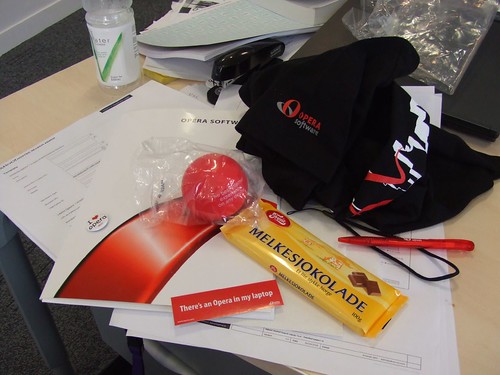
Opera Schwag

  • Schwag in form of free T-Shirts, squishy balls, badges (stating “I love Opera” and thereby being great to sell in Covent Garden at the end of a performance if you are ever really skint) and more things I cannot remember right now as I left the bag in the office when I picked up my laptop.
  • Drinks and fingerfood of the free variety. Originally every visitor had 2 drink vouchers, but the later the evening got the more of those free papers appeared miraculously (I just found two in my pocket).

The presentations had all good information, but you could see that Opera build browsers and don’t sell other products for a living. A highlight was Jeremy Keith talking about the web and HTML as a brilliant idea without his presentation or notes as his laptop died on him right at the wrong moment. His talk was a proof that if you take the instructions away from an Irishman, he’ll turn into an instant poet. It was a joy to see.

Technically there were some interesting bits to see:

  • As hinted on barcamp, Opera is working on a 3D SVG engine inside the browser, which would allow for OpenGL style apps. The 3D “Snake” adaptation they showed was a bit on the flickery and slow side, but that may be due to the presentation machine or the lack of buffering in the code.
  • Opera finally has some very impressive debugging tools that allow you to see the code as it is rendered, change the DOM, show the dimensions of an object and even use a picker to choose a colour from the page to re-use in CSS. Finally we’ll be able to fix the odd rendering bugs Opera shows from time to time easily and without guesswork.
  • One really impressive bit was to see a “labs” version of Opera that did not only do the dynamic resizing of the whole document to browser window size, but also allows you to zoom in on certain elements, effectively turning the browser into a screen magnifier.

More talks were about the History of Opera, how good it is on mobile phones, what might be in store for the mobile web and that widgets are a revolutionary great idea. Opera has been pushing their widgets into interesting environments (the Assembly demoscene event in Finland being one), but personally I used them to play some games but I fail to see the point. I don’t use the OSX Dashboard widgets, the Firefox, the Google or the Yahoo ones either. I don’t know the numbers of how many people use them but I get the impression that this novelty can wear off quickly.

In the following Q&A session I got to finally get an answer why Opera for years pretended to be MSIE - reason being that “servers” like IIS4 would not give them any HTML results if they hadn’t some recognizable ident in the navigator string (Mozilla or Explorer).

All in all I’d say it was a good meeting and made me aware of some of the things Opera is doing that I didn’t know about. It also showed me that they mean it when they say they want to support web standards and it gave me some good contacts to whinge at when some of my stuff will not work in Opera.

[tags]browsers,meetings,web standards,jeremykeith,geekdrinks,opera,schwag[/tags]