Christian Heilmann

Author Archive

Where would people like to see me – some interesting answers

Tuesday, January 27th, 2015

Will code for Bananas

For pure Shits and Giggles™ I put up a form yesterday asking people where I should try to work now that I left Mozilla. By no means I have approached all the companies I listed (hence an “other” option). I just wanted to see what people see me as and where I could do some good work. Of course, some of the answers disagreed and made a lot of assumptions:

Your ego knows no bounds. Putting companies that have already turned you down is very special behavior.

This is utterly true. I applied at Yahoo in 1997 and didn’t get the job. I then worked at Yahoo for almost five years a few years later. I should not have done that. Companies don’t change and once you have a certain skillset there is no way you could ever learn something different that might make yourself appealing to others. Know your place, and all that.

Sarcasm aside, I am always amazed how lucky we are to have choices in our market. There is not a single day I am not both baffled and very, very thankful for being able to do what I like and make a living with it. I feel like a fraud many a time, and I know many other people who seemingly have a “big ego” doing the same. The trick is to not let that stop you but understand that it makes you a better person, colleague and employee. We should strive to get better all the time, and this means reaching beyond what you think you can achieve.

I’m especially flattered that people thought I had already been contacted by all the companies I listed and asked for people to pick for me. I love working in the open, but that’s a bit too open, even for my taste. I am not that lucky – I don’t think anybody is.

The answers were pretty funny, and of course skewed as I gave a few options rather than leaving it completely open. The final “wish of the people list” is:

  • W3C (108 votes)
  • Canonical (39 votes)
  • Microsoft (38 votes)
  • Google (37 votes)
  • Facebook (14 votes)
  • Twitter (9 votes)
  • Mozilla (7 votes)
  • PubNub (26 votes)

Pubnub’s entries were having exceedingly more exclamation points the more got submitted – I don’t know what happened there.

Other options with multiple votes were Apple, Adobe, CozyCloud, EFF, Futurice, Khan Academy, Opera, Spotify (I know who did that!) and the very charming “Retirement”.

Options labeled “fascinating” were:

  • A Circus
  • Burger King (that might still be a problem as I used to work on McDonalds.co.uk – might be a conflict of interest)
  • BangBros (no idea what that might be – a Nintendo Game?)
  • Catholic Church
  • Derick[SIC] Zoolander’s School for kids who can’t read good
  • Kevin Smith’s Movie
  • “Pizza chef at my local restaurant” (I was Pizza delivery guy for a while, might be possible to level up)
  • Playboy (they did publish Fahrenheit 451, let’s not forget that)
  • Taco Bell (this would have to be remote, or a hell of a commute)
  • The Avengers (I could be persuaded, but it probably will be an advisory role, Tony Stark style)
  • UKIP (erm, no, thanks)
  • Zombocom and
  • Starbucks barista. (this would mean I couldn’t go to Sweden any longer – they really like their coffee and Starbucks is seen as the Antichrist by many)

Some of the answers were giving me super powers I don’t have but show that people would love to have people like me talk to others outside the bubble more:

  • “NASA” (I really, really think I have nothing they need)
  • “A book publisher (they need help to move into the 21st century)”
  • “Data.gov or another country’s open data platform.” (did work with that, might re-visit it)
  • “GCHQ; Be the bridge between our worlds”
  • “Spanish Government – Podemos CTO” (they might realise I am not Spanish)
  • “any bank for a11y online banking :-/”

Some answers showed a need to vent:

  • “Anything but Google or Facebook for God sake!”
  • “OK, and option 2: perhaps Twitter? You might improve their horrible JS code in the website! ;)”

The most confusing answers were “My butthole” which sounds cramped and not a creative working environment and “Who are you?” which begs the answer “Why did you fill this form?”.

Many of the answers showed a lot of trust in me and made me feel all warm and fuzzy and I want to thank whoever gave those:

  • be CTO of awesome startup
  • Enjoy life Chris!
  • Start something of your own. You rock too hard, anyway!
  • you were doing just fine. choose the one where your presence can be heard the loudest. cheers!
  • you’ve left Mozilla for something else, so you are jobless for a week or so! :-)
  • Yourself then hire me and let me tap your Dev knowledge :D

I have a new job, I am starting on Monday and I will announce in probably too much detail here on Thursday. Thanks for everyone who took part in this little exercise. I have an idea what I need to do in my new job, and these ideas listed and the results showed me that I am on the right track.

Browsers, Services and the OS – oh my…

Thursday, January 22nd, 2015

Yesterday’s two hour Windows 10 briefing by Microsoft had some very interesting things in it (The Verge did a great job live blogging it). I was waiting for lots of information about the new browser, code name Spartan, but most was about Windows 10 itself. This is, of course, understandable and shows that I care about browsers maybe too much. There was interesting information about Windows 10 being a free upgrade, Cortana integration on all platforms, streaming games from xbox to Windows and vice versa. The big wow factor at the end of the brief was HoloLens, which makes interactivity like Iron Man had in his lab not that far-fetched any longer.

hololens working

For me, however, the whole thing was a bit of an epiphany about browsers. I’ve always seen browsers as my main playground and got frustrated by lack of standards support across them. I got annoyed by users not upgrading to new ones or companies making that hard. And I was disappointed by developers having their pet browsers to support and demand people to use the same. What I missed out on was how amazing browsers themselves have become as tools for end users.

For end users the browser is just another app. The web is not the thing alongside your computing interaction any longer, it is just a part of it. Just because I spend most of my day in the browser doesn’t make it the most important thing. In esssence, the interaction of the web and the hardware you have is what is the really interesting part.

A lot of innovation I have seen over the years that was controversial at that time or even highly improbable is now in phones and computers we use every day. And we don’t really appreciate it. Google Now, Siri and now Microsoft’s Cortana integration into the whole system is amazingly useful. Yes, it is also a bit creepy and there should be more granular insight into what gets crawled and what isn’t. But all in all isn’t it incredible that computers tell us about upcoming flights, traffic problems and remind us about things we didn’t even explicitly set as a reminder?

Spartan Demo screenshot by the verge

The short, 8 minute Spartan demo in the briefing showed some incredible functionality:

  • You can annotate web page with a stylus, mouse or add comments to any part of the text
  • You can then collect these, share them with friends or watch them offline later
  • Reading mode turns the web into a one-column, easy to read version. Safari, Mobile browsers like Firefox Mobile have this and third party services like Readability did that before.
  • Firefox’s awesome bar and Chrome’s Google Now integration also is in Windows with Cortana being available anywhere in the browser.

Frankly, not all of that is new, but I have never used these features. I was too bogged down into what browsers can not do instead of checking what is already possible for normal users.

I’ve mentioned this a few times in talks lately: a lot of the innovation of add-ons, apps and products is merging with our platforms. Where in the past it was a sensible idea to build a weather app and expect people to go there or even pay for it, we get this kind of functionality with our platforms. This is great for end users, but it means we have to be up to speed what user interfaces of the platforms look like these days instead of assuming we need to invent all the time.

Looking at this functionality made me remember a lot of things promised in the past but never really used (at least by me or my surroundings):

  • Back in 2001, Microsoft introduced Smart Tags, which caused quite a stir in the writing community as it allows third party commenting on your web content without notifying you. Many a web site added the MSSmartTagsPreventParsing to disallow this. The annotation feature of Spartan now is this on steroids. Thirdvoice (wayback machine archive) was a browser add-on that did the same, but got creepy very quickly by offering you things to buy. Weirdly enough Awesome Screenshot, an annotation plug-in also now gets very creepy by offering you price comparisons for your online shopping. This shows that a functionality like that doesn’t seem to be viable as a stand-alone business model, but very much makes sense as a feature of the platform.
  • Back in 2006, Ray Ozzie of Microsoft at eTech introduced the idea of the Live Clipboard. It was this:
    [Live Clipboard…] allows the copy and pasting of data, including dynamic, updating data, across and between web applications and desktop applications.
    The big thing about this was that it would have been an industrial size use case for Microformats and could have given that idea the boost it needed. However, despite me pestering Chris Wilson of – then – Microsoft at @media AJAX 2006 about it, this never took off. Until now, it seems – except that the clippings aren’t live.
  • When I worked in Yahoo, Browser Plus came out of a hackday, an extension to browsers that allows easier file uploads and drag and drop between browser and OS. It also gave you Desktop notifications. One of the use cases shown at the hack day was to drag and drop products from several online stores and then checkout in one step with all of them. This, still, is not possible. I’d wager to guess that legal problems and tax reasons are the main blocker there. Drag and Drop and uploads as well as Desktop notifications are now reality without add-ons. So we’re getting there.

This year will be very exciting. Not only does HTML5 and JavaScript get new features all the time. It seems to me that browsers become much, much smoother at integrating into our daily lives. This spells doom for a lot of apps. Why use an app when the functionality is already available with a simple click or voice command?

Of course, there are still many issues to fix, mainly offline and slow connection use cases. Privacy and security is another problem. Convenient as it is, there should be some way to know what is listening in on me right now and where the data goes. But, I for one am very interested about the current integration of services into the browser and the browser into the OS.

Be my eyes, my brain, my second pair of eyes…

Monday, January 19th, 2015

(cross published on Medium, in case you want to comment on paragraphs).

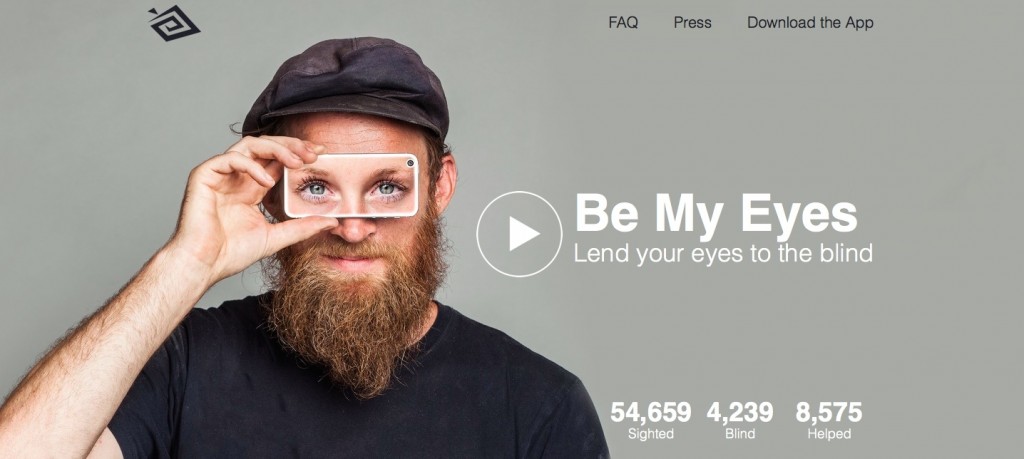
In the last few days, the “Be My Eyes” App made quite a splash. And with good reason, as it is a wonderful idea.

Be my eyes

The app plans to connect non-sighted people with sighted ones when they are stuck with a certain task. You ask for a pair of eyes, you connect over a smart phone, video the problem you have and get a volunteer human to help you out with a video call. Literally you offer to be the eyes for another person.

This is not that new, for example there were services that allow for annotation of inaccessible web content (WebVisum, IBM’s (now defunct) social accessibility project) before. But, be my eyes is very pretty and makes it much easier to take part and help people.

Only for the richer eyes…

Right now the app is iOS only, which is annoying. Whilst the accessibility features of iOS used to be exceptional it seems to be losing in quality with iOS8. Of course, the other issue is the price. Shiny Apple things are expensive, Android devices and computers with built-in cameras less so. The source code of be my eyes is on GitHub which is a great start. We might be able to see versions of it on Android and WebRTC driven versions for the web and mobile soon.

Concerns mentioned

As with any product of this ilk, concerns and criticism happen quickly:

  • This may portrait people with disabilities as people who are dependent on others to work. In essence, all you need to do is remove barriers. I know many, very independent blind people and it is depressing how many prejudices are still there that people with disabilities need our help for everything. They don’t. What they need is less people who make assumptions about abilities when building products.
  • There is a quality concern here. We assume that people signing up want to help and have good intentions. However, nothing stops trolls from using this either and deliberately giving people wrong advice. There are people who post seizure-inducing GIFs on epilepsy forums, for example. For a sociopath who wants to hurt people this could be “fun” to abuse. Personally, I want to believe that people are better than that, but only one incident where a blind user gets harmed “for the lulz” might be enough to discredit the whole product.

Extending the scope of this app

I don’t see why this app could not become more than it is now. We all could need a second pair of eyes from time to time. For example:

  • to help with some translation,
  • to recognise what breed a certain puppy is,
  • to help us find inspiration for a painting,
  • to learn how to fix a certain appliance in my kitchen without destroying it
  • to have some locals show us which roads are easier to walk,
  • to have an expert eye tell me if my makeup looks good and what could be done
  • to get fashion advice on what I could mix and match in my closet to look great

Some of those have great potential for monetisation, others were done before and died quickly (the local experts one was a product I was involved in at Yahoo called Yocal, which never saw the light of day and could have been foursquare years before foursquare).

Again, this would be nothing new: expert peer to peer systems have come and gone before. When I worked on Yahoo Answers there were discussions to allow for video upload for questions and answers. A prospect that scared the hell out of me seeing that “is my penis big enough” was one of the most asked questions in the Yahoo Answers Men’s health section (and any other, to be fair).

The defunct Google Answers had the idea to pay experts to answer your questions quickly and efficiently. Newer services like LiveNinja and AirPair do this with video chats (and Google, of course may want Hangouts to be a player in that space).

The issues that all of these services face is quality control and safety. Sooner or later any of the original attempts at this failed because of these. Skype services to pay for audio or video advice very quickly became camsex hangouts or phonesex alternatives. This even happens in the offline world – my sister used to run a call centre and they found out that one of their employees offered her phonesex services to eligible men on the line. Yikes.

Another issue is retain-ability and re-use. It is not fun to try to find a certain part of a video without a timed transcript. This can be automated to a degree – YouTube’s subtitling is a good start – but that brings up the question who else reads the private coaching session you had?

Can this be the start or will hype kill it again?

If anything, the user interface and interaction pattern of Be my Eyes is excellent, and the availability of video phones and chat abilities like WebRTC make it possible to have more of these services soon.

In the coding world, real live interaction is simple these days. JSFiddle’s collaboration button allows you to code together, JSBin allows people to watch you while you code and Mozilla’s together.js allows you to turn any web page into a live audio and video chat with multiple cursors.

We use Google Docs collaboratively, we probably have some live chat going with our colleagues. The technology is there. Firefox now has a built-in peer to peer chat system called Hello. Wouldn’t it be cool to have an API for that to embed it in your products?

The thing that might kill those is hype and inflated demands. Yahoo Answers was an excellent idea to let the human voice and communication patterns prevail over algorithmic results. It failed when all that it was measured against was the amount of users and interactions in the database. This is when the quality was thrown out the window and How is babby formed got through without a blip on the QA radar.

Let’s hope that Be my Eyes will survive the first spike of attention and get some support of people who are OK with a small amount of users who thoroughly want to help each other. I’d like to see that.

You’re a spokesperson, why do you talk about things breaking?

Friday, January 16th, 2015

Every once in a while you will find someone saying something “bad” about a product of the company they work for. This could be employees or – god forbid – even official spokespeople.

silence, please

It happens to me, too, for example when my browser crashes on me. The inevitable direct response to this is most of the time some tweet in the style of:

Should a spokesperson of $company talk badly about it? Think about the followers you have and what that means for the people who worked on the product!

It is a knee-jerk reaction making a lot of assumptions:

  • that the person is not rooting for the team,
  • that the person is abusing his or her reach,
  • that the intentions are to harm with this,
  • that criticising a product means criticising the company and
  • that the person has no respect for his or her colleagues.

Or, that they are bad at their job and cause a lot of damage without meaning to and should be chastised by some other person on Twitter.

All these could be valid points, had the person mentioneded something in a terrible way or without context. It is – of course – bad style and not professional for any employee to speak ill of their employer or its products publicly.

However, things go wrong and things break, and no matter if you are a professional spokesperson or not, it is simply honest to mention that. It also begs the question what is better: help the team that build a product to fix an obvious issue by owning the fixing process or to wait till someone else finds it? The latter means you’ll have a much shorter time to fix it.

It is ironic that an audience who hates sales pitches and advertisement is complaining when an official advocate of something points out a flaw.

It all comes down to how you mention an issue. You can cause a lot of good by mentioning an issue. Or you could cause a lot of problems.

How to report a failure and make it useful

Things you do by mentioning a fault:

  • You admit that things go wrong for you, too. That makes you a user of your products, not a salesperson (or shill, really)
  • You mention the fault before somebody else does. This puts you in the driver’s seat. Instead of reacting to criticism, you advertise that you are aware of the issue and that you are looking into it. It is better when you find a flaw than when the competition does.
  • You show that you are a user of the product. There is nothing worse than a spokesperson who only listens to what the marketing team talks about or who starts believing exclusively in their own “feel good” messages about a product. You need to use the product to be able to talk about it. And this means that you inevitably will find problems.
  • You stay approachable and honest. Things go wrong for all of us – you are no exception.

Of course, just complaining is bad form. To make your criticism something useful, you should do more:

  • Be detailed about your environment. Did you use a developer edition of your product? What’s your setup? When did the thing go wrong?
  • Stick to one thing that goes wrong. “Browser $x is unstable” is a bad message, “$x just crashed on me when trying to play this video/game” is an OK one.
  • You should report the problem internally. In the best case, this should happen before you mention it. You can then follow up your public criticism with a report how the issue is being dealt with. This step is crucial and in many cases you already find a reason why something is broken. You can then mention the issue and the solution at the same time. This is powerful – people like solutions.
  • Investigate what happened. Other people might run into the same issue and there is nothing more powerful than a post somewhere on how to fix an issue. Don’t let the thing just lie and be broken. And don’t let people come up with quick fixes or workarounds that might prove to be harmful in the long run.
  • Deal with the feedback. People fixing the issue shouldn’t have this as an extra burden. This is where your job as a spokesperson comes in: deal with feedback in a grown-up fashion and keep people updated when things get fixed or more information is unearthed why something happens.

It is very tempting to just vent when something goes wrong. This is not good. Count to ten and consider the steps above first. I am not saying that you shouldn’t report things that annoy you. On the contrary, it is part of your job to do that as it shows that you care about the product. It makes a lot of sense though to turn your gripes into actions.

When not to mention an issue

There are times though when you should not mention an issue. Not many, but there are. It mostly boils down to who will suffer by you mentioning the problem.

  • Don’t punish your users. It is a bad idea to publicly talk about a security flaw that would endanger your users. That needs immediate fixing and any public disclosure just makes it harder to fix the problem. It also is a feast for the tech press. People love a security drama and you and your press people will have to deal with a lot of half-truths and hyperbole by the press. You don’t want a bug tarnish the trust in your company as a whole, and this is what happens with premature security issue reports and the inevitable spin the press is wont to give it.
  • Don’t report without knowing who can fix the issue. Investigate who is responsible and give them a heads up. Failing this will cause massive bad blood in the company and you don’t want to have to deal with public feedback and internal grumblings and mistrust at the same time. A scorned developer is not one that will do things for you or help fixing the issue. They are much more likely to join the public conversation and strongly disagree with you and other critics. Be the person who helps fixing an issue by showing your colleagues in a light that they deal with problems swiftly and professionally. Don’t throw blame into the unknown.
  • Don’t report your own faults as problems. You might have a setup that is very unique and causes issues. Make sure you can reproduce the issue in several environments and not just one setting in a certain environment. Make sure you used the product correctly. If you didn’t, write about how you used it wrongly to avoid other false reports of bugs.

Be aware about the effects you have

Reporting bad things happening without causing internal and external issues requires good communication skills. The most important part is keeping everyone involved in the loop and be very open about the fixing process. If you can’t be sure that things will get fixed, it might not be worth your while to report them publicly. It would be a kind of blackmail or blame game you can not turn into something useful. Instead, be prepared to respond when others find the problem – as inevitably they will.

Stay honest and open and there is no problem with reporting flaws.

Photo Credit: martins.nunomiguel via Compfight cc

A time of change…

Monday, January 12th, 2015

“The suspense is killing me,” said Arthur testily.
Stress and nervous tension are now serious social problems in all parts of the Galaxy, and it is in order that this situation should not in any way be exacerbated that the following facts will now be revealed in advance.
Hitchhiker’s Guide to the Galaxy

never do anything halfway

I am not returning to Mozilla in February but go on to bring the great messages of an open web somewhere else. Where, I do not know yet. I am open to offers and I am interested in quite a few things happening right now. I want something new, with a different audience. A challenge to open and share systems and help communication where the current modus operandi is to be secretive. I want to lead a team and have a clear career path for people to follow. If you have a good challenge for me, send me some information about it.

I love everything Mozilla has done and what it stands for. I also will continue being a Mozillian. I will keep in touch with the great community and contribute to MDN and other open resources.

Of course there are many reasons for this decision, none of which need to go here. Suffice to say, I think I have done in Mozilla what I set out to do and it now needs other people to fulfil the new challenges the company faces.

I came to Mozilla with the plan to make us the “Switzerland of HTML5”, or the calming negotiator and standards implementer in the browser wars raging at that time. I also wanted to build an evangelism team and support the community in outreach on a basis of shared information and trust. I am proud of having coached a lot of people in the Mozilla community. It was very rewarding seeing them grow and share their excitement. It was great to be a spokesperson for a misfit company. A company that doesn’t worry about turning over some apple-carts if the end result means more freedom for everyone. It was an incredibly interesting challenge to work with the press in a company that has many voices and not one single communication channel. It was also great to help a crazy idea like an HTML5 based mobile operating system come to fruition and be a player people take serious.

Returning to Mozilla I’d have to start from scratch with that. Maybe it is time for Mozilla not to have a dedicated evangelism team. It is more maintainable to build an internal information network. One that empowers people to represent Mozilla and makes it easy to always have newest information.

I am looking forward to seeing what happens with Mozilla next. There is a lot of change going on and change can be a great thing. It needs the right people to stand up and come up with new ideas, have a plan to execute them and a way to measure their success.

As for me, I am sure I will miss a few things I came to love working for Mozilla. The freedoms I had. The distributed working environment. The ability to talk about everything we did. The massive resource that is enthusiasts world-wide giving their time and effort to make the fox shine.

I am looking forward to being one of them and enjoy the support the company gives me. Mozilla will be the thing I want to support and point to as a great resource to use.

Faster speed leads to more disappointment

Making the web work, keeping our information secure and private and allowing people world-wide to publish and have a voice is the job of all the companies out there.

As enthusiastic supporters of these ideas we’re not reaching the biggest perpetrators. I am looking forward to giving my skills to a company that needs to move further into this mindset rather than having it as its manifesto. I also want to support developers who need to get a job done in a limited and fixed environment. We need to make the web better by changing it from the inside. Every day people create, build and code a part of the web. We need to empower them, not to tell them that they need a certain technology or change their ways to enable something new.

The web is independent of hardware, software, locale and ability. This is what makes it amazing. This means that we can not tell people to use a certain browser to get a better result. We need to find ways to get rid of hurtful solutions by offering upgrades for them.

We have a lot of excuses why things break on the web. We fail to offer solutions that are easy to implement, mature enough to use and give the implementers an immediate benefit. This is a good new challenge. We are good at impressing one another, time to impress others.

“Keep on rocking the free web”, as Potch says every Monday in the Mozilla meeting.