Christian Heilmann

You are currently browsing the archives for the General category.

Archive for the ‘General’ Category

Mansplaining in the run down shopping mall – hybrid search engines and chatGPT solutions will be an interesting challenge

Thursday, February 9th, 2023

Machine learning generated image of the term mansplaining in the shopping mall

The race to implement the functionality of ChatGPT into the traditional search interface is on with Microsoft barging ahead taking advantage of their OpenAI partnership and Google trying to fast follow with Bard. And the hype is turned up to 11 where Google’s demo giving a wrong answer leading to a 7% drop in their share price. It is messy all around, especially when you look into the ethics of showing content without citation or having an interface too fast and immediate to moderate.

ChatGPT was a great example of how you can gain a lot of users by giving them a simple interface that does one thing well. Google used to do the same when it came about and replaced portals like Altavista and Yahoo and their bloated interfaces with thousands of links with a simple search box.

The problem with incredibly small and simple interfaces is that you also get a limited set of results. We had this with search bots in chat systems, we have this with audio interfaces like Siri, Alexa and Cortana. If all the system can do is give one answer as there is no space for more it better be the best there is. Or you get backlash like Google just encountered.

The difference that ChatGPT made compared to dumb bots or “virtual assistants” (remember the IKEA one?) is that it sounds eloquent, well researched and sensible, even when it gives the wrong result. People compared it to “mansplaining as a service”, or “CEO at a keynote” speak. This is and will remain an issue unless we find a way to fact-check the results at the same time, which might be an arms race that is hard to win.

In comparison to that, search engine results have become advertising in disguise, with the first 10 results either being flat out ads or those who spent a lot of money on advertising or shifty SEO tricks to show up first. It’s like a run-down shopping mall, with no local products or employees and chain stores selling knock-off products rather than the high quality ones.

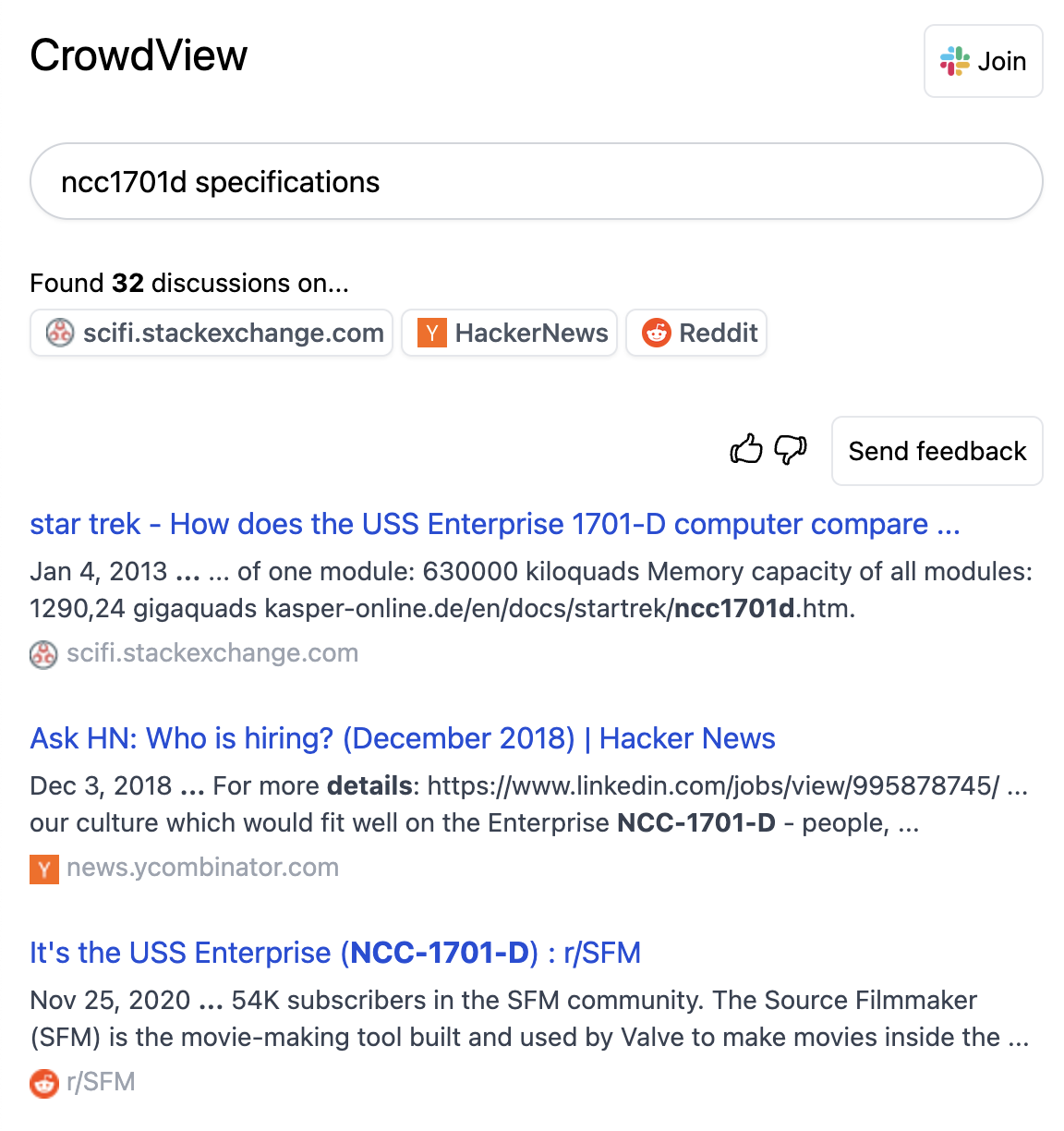
Quite some folk on the end of the long tail have given up on search engines and stick to the reddits, stackoverflows and other specialist forums instead. No surprise that there are specialist meta search engines like crowdview.ai coming up with a filtered experience.

crowdview showing results only from forum providers

This is sad, as there was a time in between where search engines started to be a lot more contextual. Their makers realised that people don’t always want a website to go to, but immediately get the result of their query. That’s why Bing and Google show a calculator interface when you enter an equation, or a weather interface when you look for “weather in x”. These quick results were excellent for the user and are a joy to encounter. The problem with them is that they cut into the view and click numbers and mean that people use your product for a shorter amount of time and don’t dwell on it so you can show more refreshing ads. Daily active user numbers don’t fill themselves, you know?

Now, how will we be able to mix the traditional search results and the low-level ChatGPT approach? Bing tries it by showing the chat interface in a sidebar and giving it much more recent, sometimes brand new content and context.

Smaller players try the same thing, for example You.com being a search engine that offers a normal search or a chat interface side-by-side.

You.com showing results for a music query

This looks amazing, as it shows the answer next to the traditional search results. It still is a UX challenge to make the two compete with another, and it will be interesting to see what the usage numbers show. Will the chat interface prevail, or is it a new and cool thing people will try until it fails for them and then move back to the tried and true approach?

In any case, I love that the heat is on in the search market, as it was ripe for disruption once more. When Google showed that you don’t need to give people thousands of options but spend more time on analysing their query and give them what they need instead. Now we can analyse more deeply and give people not only what they are looking for but what may be interesting in context. But we need to get it right and this is where I am worried. When I buy a toilet lid on Amazon, I get lots of offers for buying more and ads for toilet lids in Instagram. I wasn’t planning on starting a collection, even if that would be great for the consumer platforms.

An easy way to copy + paste from the browser Console #shorts

Monday, February 6th, 2023

Copying and pasting from Console is annoying but there is a better way. The Console variable $_ contains the last result. You can use this with the copy() command to copy the data to the clipboard without having to highlight it.

MacOS can remove image backgrounds #shorts

Monday, February 6th, 2023

Today I learned that MacOS can remove backgrounds from images, much like remove.bg does.

All you need to do is right-click an image and select Quick Actions > Remove Background.

Remove background option of the finder context menu.

For example, it turned this image

Chris Heilmann holding a cup

into this one:

Same images as earlier but with removed background

Releasing code in large corporations is slow – and there is a good reason for it

Tuesday, January 31st, 2023

Person ticking boxes on a todo list

One of the things I always loved about the web is its immediacy. You write a piece of code, publish it somewhere and people can access it. No compilation step, no packaging and distribution, no listing on marketplaces or app stores – just a push of the button.

This gives people a wrong impression that this way of working should scale to products and large companies as well. Often it feels like fast and nimble startups that can “fail fast and often” are the ones that do it right whereas larger, older corporations feel like slow moving dinosaurs in comparison. It gets interesting when you look at the maturity of the products released. Products in “preview” or perpetual “beta” are quick to turn around, whereas full versions need to do a lot more than just provide the functionality.

The main difference is that full version releases in large companies have compliance to consider. Internal quality compliance, and – to a much larger degree – external legal compliance. When I started working in Microsoft and transitioned from developer to product manager I realised that a lot of work and effort go into things that need to be done before we could release a product.

  • Security – is the product safe from attacks?
  • Performance
    • Does the product run fast and smooth?
    • How much does it impact the overall byte size and speed of the possible parent product (browser, OS…)
  • Maintainability
    • Does the product rely on third party code that may be unavailable in the future or poses a licensing problem?
    • Does the product require a platform or language that might not be supported in the nearer future?
  • Privacy
    • Does the product record information that could make its users identifiable?
    • Where does the information go?
    • Are you using third party software packages that could also get that information?
  • Compliance
    • Are users aware of their information that is being recorded?
    • Is the information retained for only a short amount of time or long term?
    • Can people opt out?
    • Is the product available in different markets in different languages?
    • Does the product adhere to local legislation?
    • Is the product accessible to all?

Each of these have a process you need to go through, dependent on expert departments in the company, review cycles and bug reports that need fixing. So whilst your product may work already, this normally adds at least a few weeks to the release. Worse even, every change to the product restarts this cycle.

Frustrating, yes – but incredibly important

This can be incredibly annoying to encounter and seeing a product that is code complete move from sprint to sprint because of unavailability of reviewers or bugs that are an issue but can’t be fixed is frustrating. I had to deal with a lot of accessibility issues that only appeared in third party software, for example Voiceover on Mac or Orca on Linux systems. And whilst my team did everything right, our products didn’t work with those. Filing reports didn’t make much of a difference, so often we had to make functionality of a product opt-in with it being turned off by default to work around these problems.

This was frustrating for all involved, as some of this functionality was a differentiator that could have resulted in lots of new users. But as it became an opt-in, this is already a surefire way to not get many users of this feature.

But the fact of the matter remains that everything we do as software developers has a direct impact on end users out there. It might be a shortcut for us to not cover all edge cases, but it may mean that our product can leak information of our users which can lead to their identities being stolen.

We could block users as we didn’t think that any person who can’t use a mouse would ever use our product. I spent quite some time making a colour picker tool available to screen readers. This feels not necessary, but the point is that not every screenreader user is unable to see at all. By making it easier to use and adding more labels, the tool became more convenient for all users.

In the end, what counts is the end user experience. And whilst iterating fast and trying out a lot of cool new ways to interact with information is exciting, it may mean that we lock out a lot of potential users who can’t change their setup, or – worse – what their bodies can do. And whilst some of the legal requirements like GDPR feel like overkill, they may be a good way for us to reflect on how much information we need from our users and what we do with it.

How can we move faster?

The great thing about compliance is that it is predictable. We will have to do it in large corporations and certain areas of publication. So we might as well plan for it as soon as we can – even in the design and planning phase of the project. The biggest non-news about accessibility, for example, is that the earlier to take care of it, the fewer work you have to do. Making an already existing product accessible is playing whack-a-mole with assistive technology support, cross-platform issues and framework support. Planning it to be as accessible as needed from the get-go, or using already tested, accessible components means compliance can be a matter of hours, not weeks.

The same goes for data we record and want to retain. It is not often that we come up with something brand new – often we just add a feature to an existing product. So the question is if it really is necessary to add telemetry to every interface element, or maybe dig into what we already get from the parent product.

I’ll dig more into this in another post, as there are ways to cater to compliance needs and still move fast. But for now, it is important to remember that developers in large corporations aren’t slower or less switched on than those in the wild. They just have to care about a lot more than just writing the code. And that – to me – is a good thing, as what we write can make or break the online experience of our users.

Photo by Glenn Carstens-Peters on Unsplash

Things to do and not to do during a wave of tech layoffs

Tuesday, January 24th, 2023

Chris Heilmann wearing a T-Shirt saying "My mom says I'm a catch" and holding a coffee cup stating "do epic shit"

Currently we are in a huge round of tech layoffs that are reminiscent of the first .com crash in the beginning of the century. Meta, Amazon, Microsoft and now Google announced layoffs in the 10k range and it seems no one is spared. New people as well as people who have been at companies for over 20 years all got the meeting we all dread.

I also got laid off and I am currently still in negotiations about the details, so there will be a different post on that. This isn’t my first rodeo, and I am in a lead position which is why I get a lot of requests from annoyed and desperate colleagues asking for advice. So here are some things I tell myself right now and others that may be of help if you’re affected or you know someone who is.

Leaving people in the unknown is the worst

Layoffs get a lot worse when there is inconsistency and unknowns. Giving a lot of people the sack with a generous severance offer and some safety packages like CV help is bad, but there is still a resemblance of care for the person rather than the employee number. Announcing that you lay off a certain number of people and then telling your staff that the announcements will happen over the next few weeks and months is just cruel. Sure, there are some legal requirements in certain countries that don’t allow for full disclosure until a contract is signed, but any company thinking that keeping people in the unknown – at any company decision – is a good way to get more out of them or save money is deluded. I once heard the term “mushroom management” – keep your employees in the dark and from time to time cover them in shit. Don’t be that company. If you are in this situation, I am sorry, but stay strong and do your job like you would have. Most likely you have fewer colleagues to work with now, so there is a big chance that there is a lot to do. If you already know that you are laid off, tell people who rely on you for information and sign-off that you are. Leaving any unknown, even the small ones, known is a good thing.

Don’t leave in anger

Layoffs suck. There is no winner. The people involved, of course, are the biggest losers, but it is also a massive toll on managers and HR folk that have to be the messenger. These layoffs right now are not about performance, how you networked in the company or what you work on. They are a knee-jerk reaction to a perceived recession and a band-aid to make stocks go up again. When your profitability per head is low, heads must roll.

Keeping that in mind, it is important to remember that the tech market, albeit being important and very rich, is also small. So don’t let your anger out on your colleagues. Don’t shoot the messengers and don’t go out in public and vent about your company in the spur of the moment and with inappropriate language and accusations. You will cross paths with many people you worked with again. There is also a big chance that your next company will work with your old one. And being a person that still has a foot in the door instead of having slammed it in many faces is something that can be a benefit to you then.

Leave a clean desk

If possible, leave a clean desk. Delete all meetings you own on the company calendar as they may show up as indelible ghosts for months afterwards. Document what you have done, where to find information and offer to do handover meetings with colleagues who are still around. I say “if possible” because in many, especially US environments that isn’t even a thing. If you’re laid off, you’re gone. A day later. This is borderline sabotage to your own company. People accumulate knowledge, documents, access to systems and many more things you don’t want to lose immediately. Not having access to a dashboard or a compliance form that needs to be filled out every quarter is going to be a lot of work for your team – a team that already lost people who are not getting replaced any time soon.

Brush up your CV and networking profiles

In order to get a new job, you will need a good CV. Go and write one and ask people you trust to review it. Also clean up your networking profiles like LinkedIn and ask for recommendations and reviews from people you worked with. This is quite a time to get a lot of “advice” on job portals on this topic and there are a lot of “CV expert companies” offering you their services. It is important to remember though that companies are flooded with offers from people and that HR folks have only a short amount of time to look at any CV. So the things that worked for me are:

  • Have a PDF/Word document CV - nobody wants to go to a web site and look at 8 minutes of parallax effects and videos.
  • List all your contact details and where you legally can work as the first thing.
  • List what you are looking for.
  • Have different CVs, catered to what’s important for the role in question.
  • Prepare for having to copy and paste all the things into some company internal hiring portal.

Take as much as you can with you

If you live in a country with good work laws, then there is a period of a few weeks where you are on administrative leave. Take this time to look at perks your company offers and use them. In my case, I am going to look at a lot of courses and certifications we offer to third parties but I have never taken. You might also have access to cheaper hardware or software licences that are a bargain to take with you. And of course contact people in the company telling them that you are off and what you liked about working with them. This doesn’t only give them a fuzzy feeling but it is also a good thing for you to remember the good bits in a time of anger and confusion.

Don’t use company resources for personal things

Your work laptop, your access to company software packages and resources are handy to have but they are not yours any more. You will also soon have no access to them any longer. So get your own devices and use these to write your CVs and contact people from personal accounts. If things get messy with your employer beyond a clean severance, any use of company resources could be a problem for you.

Don’t allow yourself to get badgered

With all due respect and apologies to the poor HR people who have to deal with this, but there is one thing that’s incredibly important. Leaving a company in a round of layoffs like these is as much a negotiation as joining a company is. So don’t sign the first offer without getting enough time to look at it and check what it means. A big bunch of money does sound good but it also can get eaten up by taxes. If you have a union representative in the company, contact them and demand them to be in every meeting. If you can afford a specialist lawyer, send the papers to them and let them do the negotiations for you. Hopefully your company knows your worth and offers you what you are due, but I’ve encountered quite a few times that the first offer that “you have to sign in two days” is much lower than you should go for.

Another thing that drives me nuts is advice you get on social media from people who “love the hustle” and see every layoff as an opportunity to “do your own thing”. You have a right to grieve and reflect now. Don’t let yourself get stressed out by amazing things that could be if you act immediately. You’ve just been punched, it is OK to recover first before picking the next argument.

Don’t take it personally – it wasn’t you

This is easy to say and of course you feel like shit when you get laid off. It is also tempting to see the fault in you and get desperate about your future. This time, it is not. If you were laid off because of your performance any time in between these huge attempts to fix capitalism it might be a different thing. But even then it may have been that you have just had the wrong job or tried to tell you that you can do it because of a good paycheck although it just wasn’t your cup of tea. It is OK to grieve though. It is OK to reflect and look at places where you can improve. But it is not necessary to beat yourself up. Talk to people, go out, do nothing and especially nothing with computers and phones. Vent in ways that are good for you and don’t inconvenience others. Angry music with headphones works for me.

Be there for others

If you worked in a place resembling some human society, you will have colleagues that reach out to you and tell you how sorry they are. Take these moments and thank them. Also reach out to people who have been laid off and just offer to be available for a chat. These are annoying, frustrating and bad times, and there is period of flooded job markets and even more layoffs coming.

I am pretty swamped, but if you feel like a quick chat, you can send me an email or reach out on LinkedIn.