Christian Heilmann

Author Archive

Slimming down the web: Remove code to fix things, don’t add the “clever” thing

Wednesday, July 8th, 2015

Today we saw a new, interesting service called Does it work on Edge? which allows you to enter a URL, and get that URL rendered in Microsoft Edge. It also gives you a report in case there are issues with your HTML or CSS that are troublesome for Edge (much like Microsoft’s own service does). In most cases, this will be browser-specific code like prefixed CSS. All in all this is a great service, one of many that make our lives as developers very easy.

If you release something on the web, you get feedback. When I tweeted enthusiastically about the service, one of the answers was by @jlbruno, who was concerned about the form not being keyboard accessible.

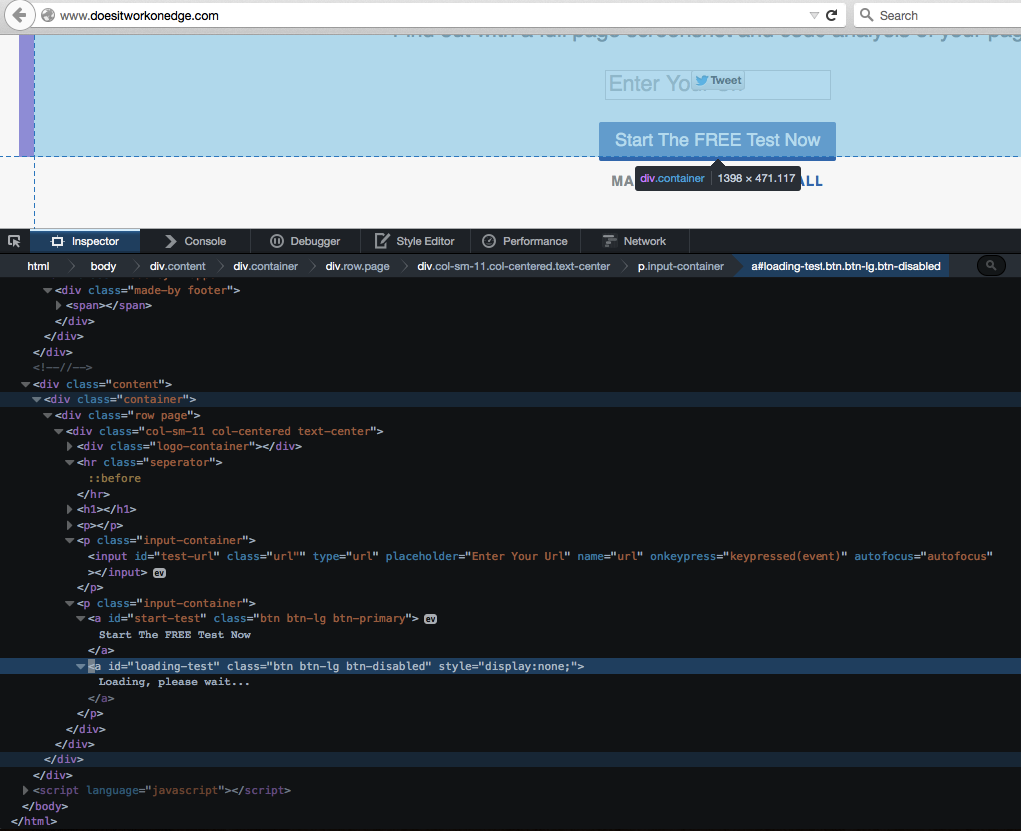
The reason for this is simple: the form on the site itself is none insofar there is no submit button of any kind. The button in the page is a anchor pointing nowhere and the input element itself has a keypress event attached to it (even inline):

screenshot of the page source codeclick for bigger

There’s also another anchor that points nowhere that is a loading message with a display of none. Once you click the first one, this one gets a display of block and replaces the original link visually. This is great UX - telling you something is going on – but it only really works when I can see it. It also gives me a link element that does nothing.

Once the complaint got heard, the developers of the site took action and added an autofocus attribute to the input field, and proudly announcing that now the form is keyboard accessible.

Now, I am not having a go here at the developers of the site. I am more concerned that this is pretty much the state of web development we have right now:

  • The visual outcome of our tools is the most important aspect – make it look good across all platforms, no matter how.
  • As developers, we most likely are abled individuals with great computers and fast connections. Our machines execute JavaScript reliably and we use a trackpad or mouse.
  • When something goes wrong, we don’t analyse what the issue is, but instead we look for a tool that solves the issue for us – the fancier that tool is, the better

How can this be keyboard accessible?

In this case, the whole construct is far too complex for the job at hand. If you want to create something like this and make it accessible to keyboard and mouse users alike, the course of action is simple:

  • Use a form elment with an input element and a submit button

Use the REST URL of your service (which I very much assume this product has) as the action and re-render the page when it is done.

If you want to get fancy and not reload the page, but keep all in place assign a submit handler to the form element, call preventDefault() and do all the JS magic you want to do:

  • You can still have a keypress handler on the input element if you want to interact with the entries while they happen. If you look at the code on the page now, all it does is check for the enter button. Hitting the enter button in a form with a submit button or a button element submits the form – this whole code never has to be written, simply by understanding how forms work.
  • You can change the value of a submit button when the submit handler kicks in (or the innerHTML of the button) and make it inactive. This way you can show a loading message and you prevent duplicate form submissions

What’s wrong with autofocus?

Visually and functionally on a browser that was lucky enough to not encounter a JavaScript error until now, the autofocus solution does look like it does the job. However, what it does is shift the focus of the document to the input field once the page has loaded. A screenreader user thusly would never ever learn what the site is about as you skip the header and all the information. As the input element also lacks a label, there isn’t even any information as to what the user is supposed to enter here. You sent that user into a corner without any means of knowing what’s going on. Furthermore, keyboard users are primed and ready to start navigating around the page as soon as it loads. By hijacking the keyboard navigation and automatically sending it to your field you confuse people. Imagine pressing the TV listings button on a TV and instead it just sends you to the poodle grooming channel every time you do it.

The web is obese enough!

So here’s my plea in this: let’s break that pattern of working on the web. Our products don’t get better when we use fancier code. They get better when they are easier to use for everybody. The fascinating bit here is that by understanding how HTML works and what it does in browsers, we can avoid writing a lot of code that looks great but breaks very easily.

There is no shortage of articles lamenting how the web is too slow, too complex and too big on the wire compared to native apps. We can blame tools for that or we could do something about it. And maybe not looking for a readymade solution or the first result of Stackoverflow is the right way to do that.

Trust me, writing code for the web is much more rewarding when it is your code and you learned something while you implemented it.

Let’s stop adding more when doing the right thing is enough.

Over the Edge: Web Components are an endangered species

Wednesday, July 1st, 2015

Last week I ran the panel and the web components/modules breakout session of the excellent Edge Conference in London, England and I think I did quite a terrible job. The reason was that the topic is too large and too fragmented and broken to be taken on as a bundle.

If you want to see the mess that is the standardisation effort around web components right now in all its ugliness, Wilson Page wrote a great post on that on Mozilla Hacks. Make sure to also read the comments – lots of good stuff there.

Web Components are a great idea. Modules are a great idea. Together, they bring us hours and hours of fun debating where what should be done to create a well-performing, easy to maintain and all around extensible complex app for the web. Along the way we can throw around lots of tools and ideas like NPM and ES6 imports or – as Alex Russell said it on the panel: “tooling will save you”.

It does. But that was always the case. When browsers didn’t support CSS, we had Dreamweaver to create horribly nested tables that achieved the same effect. There is always a way to make browsers do what we want them to do. In the past, we did a lot of convoluted things client-side with libraries. With the advent of node and others we now have even more environments to innovate and release “not for production ready” impressive and clever solutions.

When it comes to componentising the web, the rabbit hole is deep and also a maze. Many developers don’t have time to even start digging and use libraries like Polymer or React instead and call it a day and that the “de facto standard” (a term that makes my toenails crawl up – layout tables were a “de facto standard”, so was Flash video).

React did a genius thing: by virtualising the DOM, it avoided a lot of the problems with browsers. But it also means that you forfeit all the good things the DOM gives you in terms of accessibility and semantics/declarative code. It simply is easier to write a than to create a fragment for it or write it in JavaScript.

Of course, either are easy for us clever and amazing developers, but the fact is that the web is not for developers. It is a publishing platform, and we are moving away from that concept at a ridiculous pace.

And whilst React gives us all the goodness of Web Components now, it is also a library by a commercial company. That it is open source, doesn’t make much of a difference. YUI showed that a truckload of innovation can go into “maintenance mode” very quickly when a company’s direction changes. I have high hopes for React, but I am also worried about dependencies on a single company.

Let’s rewind and talk about Web Components

Let’s do away with modules and imports for now, as I think this is a totally different discussion.

I always loved the idea of Web Components – allowing me to write widgets in the browser that work with it rather than against it is an incredible idea. Years of widget frameworks trying to get the correct performance out of a browser whilst empowering maintainers would come to a fruitful climax. Yes, please, give me a way to write my own controls, inherit from existing ones and share my independent components with other developers.

However, in four years, we haven’t got much to show.. When we asked the very captive and elite audience of EdgeConf about Web Components, nobody raised their hand that they are using them in real products. People either used React or Polymer as there is still no way to use Web Components in production otherwise. When we tried to find examples in the wild, the meager harvest was GitHub’s time element. I do hope that this was not all we wrote and many a company is ready to go with Web Components. But most discussions I had ended up the same way: people are interested, tried them out once and had to bail out because of lack of browser support.

Web Components are a chicken and egg problem where we are currently trying to define the chicken and have many a different idea what an egg could be. Meanwhile, people go to chicken-meat based fast food places to get quick results. And others increasingly mention that we should hide the chicken and just give people the eggs leaving the chicken farming to those who also know how to build a hen-house. OK, I might have taken that metaphor a bit far.

We all agreed that XHTML2 sucked, was overly complicated, and defined without the input of web developers. I get the weird feeling that Web Components and modules are going in the same direction.

In 2012 I wrote a longer post as an immediate response to Google’s big announcement of the foundation of the web platform following Alex Russell’s presentation at Fronteers 11 showing off what Web Components could do. In it I kind of lamented the lack of clean web code and the focus on developer convenience over clarity. Last year, I listed a few dangers of web components. Today, I am not too proud to admit that I lost sight of what is going on. And I am not alone. As Wilson’s post on Mozilla Hacks shows, the current state is messy to say the least.

We need to enable web developers to use “vanilla” web components

What we need is a base to start from. In the browser and in a browser that users have and doesn’t ask them to turn on a flag. Without that, Web Components are doomed to become a “too complex” standard that nobody implements but instead relies on libraries.

During the breakout session, one of the interesting proposals was to turn Bootstrap components into web components and start with that. Tread the cowpath of what people use and make it available to see how it performs.

Of course, this is a big gamble and it means consensus across browser makers. But we had that with HTML5. Maybe there is a chance for harmony amongst competitors for the sake of an extensible and modularised web that is not dependent on ES6 availability across browsers. We’re probably better off with implementing one sci-fi idea at a time.

I wished I could be more excited or positive about this. But it left me with a sour taste in my mouth to see that EdgeConf, that hot-house of web innovation and think-tank of many very intelligent people were as confused as I was.

I’d love to see a “let’s turn it on and see what happens” instead of “but, wait, this could happen”. Of course, it isn’t that simple – and the Mozilla Hacks post explains this well – but a boy can dream, right? Remember when using HTML5 video was just a dream?

That stream of tweets at conferences…

Sunday, June 21st, 2015

A few weeks ago, I wrote the That One Tweet post explaining how one tweet managed to puncture my balloon of happy and question if my work is appreciated. All of this is caused the gremlin of self-doubt living in all of us and it was mostly a reminder to tell it to mind its own business.

Currently writing event reports, I think it would be terrible of me not to mention the other side of this. I want to take this opportunity to thank deeply and thoroughly people who use twitter to report, comment and encourage presenters and organisers of events. You rock, so here’s a hedgehog wizard to tell you as much:

hedgehog dressed as a wizard

I was very humbled and lucky to be at a few events in the last weeks where the audience used Twitter not only to post selfies and tell the world where they are, but also to report and keep a running commentary on talks. Others delivered beyond expectation by doing sketchnotes and posting those. I am humbled by and jealous of your creativity and dedication. Having good Twitter feedback has numerous effects that inflate my happy balloon:

  • It is superbly rewarding to see people deeply care about what you do.
  • It is insightful to see the tidbits of information people extract from your talks and what they considered quote-worthy. Yes, that can also be scary, but is a good reminder to explain some bits in better details next time
  • It makes my professional life so much easier as I can collect feedback and show it to my managers and outreach departments.
  • It allows me to show people that a personal touch and a presenter showing his or her views is much more beneficial to a company than a very polished slide deck people have to present
  • It shows me that I reach people with what I do. Feedback is scarce, and whilst immediate feedback tends to be highly polarised I have something to ponder
  • It gives me a fuzzy feeling when people find the need to align themselves with an event and tell the world how much of a good time they have. We have no lack of soulless events that people go to because they get a random ticket or to drop off as many business cards as they can. It feels great to see attendees go all in and praise an event for being different.
  • ROI of events is tough to measure. By being able to quote tweets, show people’s blog posts and photos I have ammunition to show people why my time there and our money in the support pot of events is worth it.

So, here’s to the people who give feedback on talks and events on Twitter. You make me happy like this puppy:

Incredibly happy puppy

Keep up the great work, you can be sure that it is very appreciated by presenters and conference organisers alike

UA Sniffing issue: Outdated PageSpeed sending WebP images to Microsoft Edge

Monday, June 8th, 2015

PageSpeed by Google is a great way to add clever performance enhancements to your site without having to do a lot by hand. Not surprisingly, a lot of people used it when it came out. Sadly enough, people then don’t upgrade it when Google does which means there are a lot of sub-optimal installations out there.

This wouldn’t be an issue, if the old versions didn’t use user agent sniffing to try to detect a browser, which leads to a lot of false positives.

Dogs sniffing each others backsides
Figure 1: User Agent Sniffing in action

One of these false positives is that Microsoft Edge Mobile is detected as Chrome, which means that PageSpeed converts images to WebP. MS Edge does not support WebP, which is why you’ll have broken images:

broken images on faz.net

The fix: upgrade PageSpeed

The fix is easy: just upgrade your PageSpeed to the latest version as the team moved on from UA Sniffing. There should not be any backwards compatibility issues. Upgrading can be done via package managers on Apache, but with NGINX, it requires compilation. Version 1.8 was the first version that turned on WebP transcoding by default. Version 1.9 fixed it by making sure it worked off of accept header rather than UA string.

How to test if your server does it right

If you want to test if a server does the right thing (which is using accept headers instead of UA sniffing), use MS Edge.

A quick and dirty way is also to change your user agent string to the following and surf to the site. This is effectively doing reverse sniffing, so it is OK to detect falsy detection scripts, but not a good idea to do real capability/interoperability testing.

Mobile UA String for Edge (please, don’t use for sniffing)

Mozilla/5.0 (Windows Phone 10; Android 4.2.1; Microsoft; NOKIA) AppleWebKit/537.36 (KHTML, like Gecko) Chrome/36.0.1985.143 Mobile Safari/537.36 Edge/12.0

Desktop UA String for Edge (please, don’t use for sniffing)

Mozilla/5.0 (Windows NT 10.0; WOW64) AppleWebKit/537.36 (KHTML, like Gecko) Chrome/39.0.2171.71 Safari/537.36 Edge/12.0

You can do this in most developer tools (I use the User Agent Switcher extension in Firefox which is also available for Chrome). If you are on Windows/IE or MS Edge, you can go to the F12 developer tools and change the browser profile to “phone”.

Got it fixed? Thanks! Tell us so we can praise you

If you upgraded and fixed this interop issue, feel free to ping me or @MSEdgeDev and we’ll be happy! Let’s fix the web, one bad sniff at a time.

That one tweet…

Saturday, May 30th, 2015

One simple tweet made me feel terrible. One simple tweet made me doubt myself. One simple tweet – hopefully not meant to be mean – had a devastating effect on me. Here’s how and why, and a reminder that you should not be the person that with one simple tweet causes anguish like that.

you don't know the struggle someone had to go through to get where they are

Beep beep, I’m a roadrunner

As readers of this blog, you know that the last weeks have been hectic for me:

I bounced from conference to conference, delivering a new talk at each of them, making my slides available for the public. I do it because I care about people who can not get to the conference and for those I coach about speaking so they can re-use the decks if they wanted to. I also do a recording of my talks and publish them on YouTube so people can listen. Mostly I do these for myself, so I can get better at what I do. This is a trick I explained in the developer evangelism handbook – another service I provide for free.

Publishing on the go is damn hard:

  • Most Wi-Fi at events is flaky or very slow.
  • I travel world-wide which means I have no data on my phone without roaming and such.
  • Many times uploading my slides needs four to five attempts
  • Creating the screencast can totally drain the battery of my laptop with no power plug in sight.
  • Uploading the screencast can mean I do it over night.

The format of your slides are irellevant to these issues. HTML, Powerpoint, Keynote – lots of images means lots of bytes.

Traveling and presenting is tough – physical space still matters

Presenting and traveling is both stressful and taxing. Many people ask me how I do it and my answer is simply that: the positive feedback I get and seeing people improve when they get my advice is a great reward and keeps me going. The last few weeks have been especially taxing as I also need to move out of my flat. I keep getting calls by my estate agent that I need to wire money or be somewhere I can not. I also haven’t seen my partner more than a few hours because we are both busy.

I love my job. I still get excited to go to conferences, hear other presenters, listen to people’s feedback and help them out. A large part of my career is based on professional relationships that formed at events.

The lonely part of the rockstar life

Bill Murray in Lost in Translation

Being a public speaker means you don’t spend much time for yourself. At the event you sleep on average 4-5 hours as you don’t want to be the rockstar presenter that arrives, delivers a canned talk and leaves. You are there for the attendees, so you sacrifice your personal time. That’s something to prepare for. If you make promises, you also need to deliver them immediately. Any promise of you to look into something or contact someone you don’t follow up as soon as you can piles up to a large backlog you have a hard time remembering what it is you wanted to find out.

It also can make you feel very lonely. I’ve had many conversations with other presenters who feel very down as you are not with the people you care about, in the place you call home or in an environment you understand and feel comfortable in. Sure, hotels, airports and conference venues are all lush and have a “jet set” feel to them. They are also very nondescript and make you feel like a stranger.

Progressive Enhancement discussions happen and I can’t be part of it!

I care deeply about progressive enhancement. To me, it means you care more for the users of your products than you care about development convenience. It is a fundamental principal of the web, and – to me – the start of caring about accessibility.

In the last few weeks progressive enhancement was a hot topic in our little world and I wanted to chime in many a time. After all, I wrote training materials on this 11 years ago, published a few books on it and keep banging that drum. But, I was busy with the other events on my backlog and the agreed topics I would cover.

That’s why I was very happy when “at the frontend” came up as a speaking opportunity and I submitted a talk about progressive enhancement. In this talk, I explain in detail that it is not about the JavaScript on or off case. I give out a lot of information and insight into why progressive enhancement is much more than that.

That Tweet

Just before my talk, I uploaded and tweeted my deck, in case people are interested. And then I get this tweet as an answer:

Yehuda Katz: @codepo8, I can't see your slides without JavaScript

It made me angry – a few minutes before my talk. It made me angry because of a few things:

  • it is insincere – this is not someone who has trouble accessing my content. It is someone who wants to point out one flaw to have a “ha-ha you’re doing it wrong” moment.
  • the poster didn’t bother to read what I wrote at all – not even the blog post I wrote a few days before covering exactly the same topic or others explaining that the availability of JS is not what PE is about at all.
  • it judges the content of a publication by the channel it was published on. Zeldman wrote an excellent piece on this years ago how this is a knee-jerk reaction and an utter fallacy.
  • it makes me responsible for Slideshare’s interface – a service used my many people as a great place to share decks
  • it boils the topic I talked about and care deeply for down to a simple binary state. This state isn’t even binary if you analyse it and is not the issue. Saying something is PE because of JavaScript being available or not is the same technical nonsense that is saying a text-only version means you are accessible.

I posted the Zeldman article as an answer to the tweet and got reprimanded for not using any of the dozens available HTML slide deck versions that are progressively enhancing a document. Never mind that using keynote makes me more effective and helps me with re-use. I have betrayed the cause and should do better and feel bad for being such a terrible slide-creator. OK then. I shrugged this off before, and will again. But, this time, I was vulnerable and it hurt more.

Siding with my critics

I addition to me having lot of respect of what Yehuda achieved other people started favouriting the tweet. People I look up to, people I care about:

  • Alex Russel, probably one of the most gifted engineers I know with a vocabulary that makes a Thesaurus blush.
  • Michael Mahemoff, always around with incredibly good advice when HTML5 and apps where the question.
  • My colleague Jacob Rossi, who blows me away every single day with his insight and tech knowledge

And that’s when my anger turned inward and the ugly voice of impostor syndrome reared its head. Here is what it told me:

  • You’re a fool. You’re making a clown of yourself trying to explain something everyone knows and nobody gives a shit about. This battle is lost.
  • You’re trying to cover up your loss of reality of what’s needed nowadays to be a kick-ass developer by releasing a lot of talks nobody needs. Why do you care about writing a new talk every time? Just do one, keep delivering it and do some real work instead
  • Everybody else moved on, you just don’t want to admit to yourself that you lost track.
  • They are correct in mocking you. You are a hypocrite for preaching things and then violating them by not using HTML for a format of publication it wasn’t intended for.

I felt devastated, I doubted everything I did. When I delivered the talk I had so looked forward to and many people thanked me for my insights I felt even worse:

  • Am I just playing a role?
  • Am I making the lives of those who want to follow what I advocate unnecessarily hard?
  • Shouldn’t they just build things that work in Chrome now and burn them in a month and replace them with the next new thing?

Eventually, I did what I always do and what all of you should: tell the impostor syndrome voice in your head to fuck off and let my voice of experience ratify what I am doing. I know my stuff, I did this for a long time and I have a great job working on excellent products.

Recovery and no need for retribution

I didn’t have any time to dwell more on this, as I went to the next conference. A wonderful place where every presentation was full of personal stories, warmth and advice how to be better in communicating with another. A place with people from 37 countries coming together to celebrate their love for a product that brings them closer. A place where people brought their families and children although it was a geek event.

I’m not looking for pity here. I am not harbouring a grudge against Yehuda and I don’t want anyone to reprimand him. My insecurities and how they manifest themselves when I am vulnerable and tired are my problem. There are many other people out there with worse issues and they are being attacked and taken advantage of and scared. These are the ones we need to help.

Think before trying to win with a tweet

What I want though is to make you aware that everything you do online has an effect. And I want you to think next time before you post the “ha-ha you are wrong” tweet or favourite and amplify it. I want you to consider to:

  • read the whole publication before judging it
  • question if your criticism really is warranted
  • wonder how much work it was to publish the thing
  • consider how the author feels when the work is reduced to one thing that might be wrong.

Social media was meant to make media more social. Not to make it easier to attack and shut people up or tell them what you think they should do without asking about the how and why.

I’m happy. Help others to be the same.