Christian Heilmann

You are currently browsing the Christian Heilmann blog archives for August, 2026.

Archive for August, 2026

Quick Tip: Translating long documents with Microsoft Edge Immersive Reader

Wednesday, August 12th, 2026

Translating documents isn’t hard these days, but when it comes to long documents, it still gets tricky as most translation services are limited to a few paragraphs and charge for larger texts.

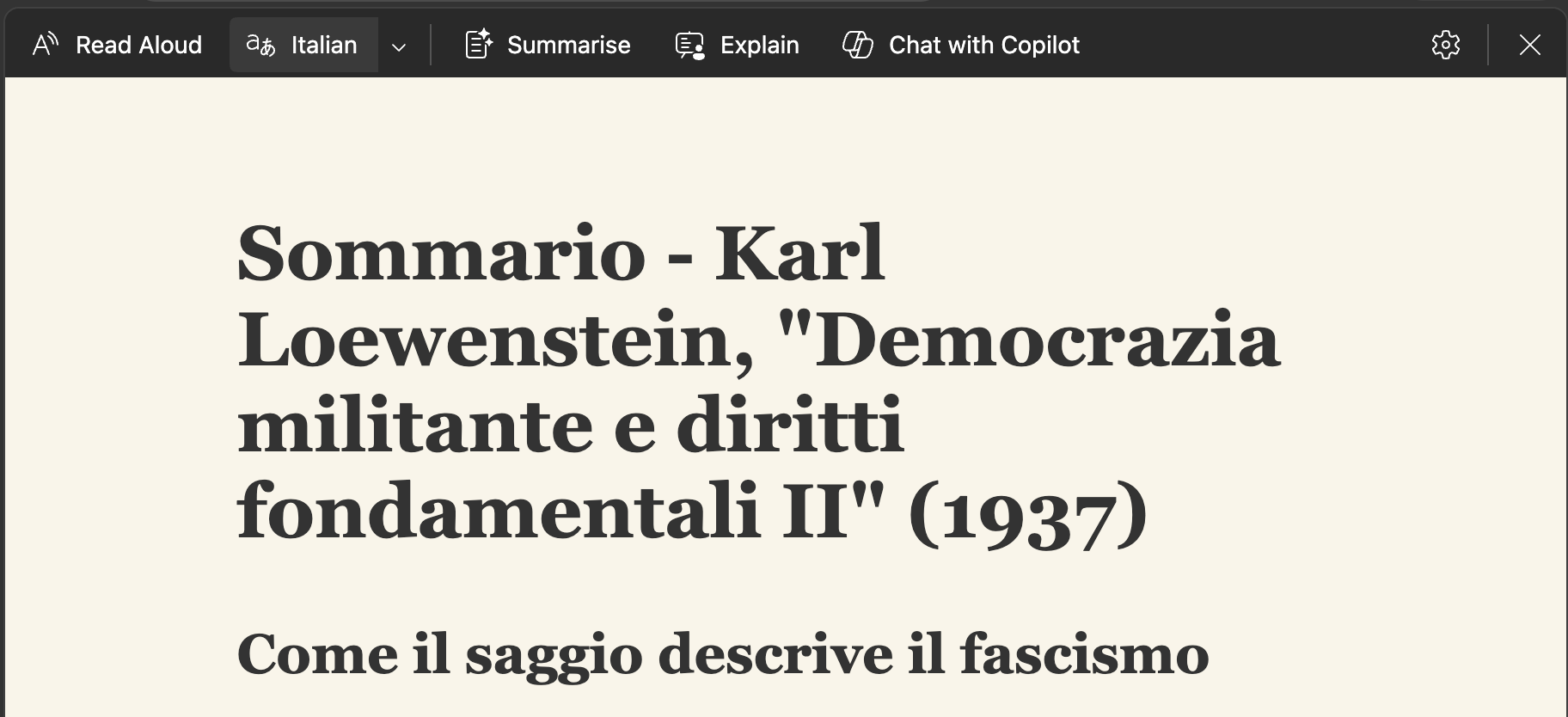
If you use Microsoft Edge, you can use the immersive reader mode to translate huge documents for free though. You can trigger the immersive reader on any text heavy document by activating the icon on the URL bar.

The immersive reader icon in the URL bar

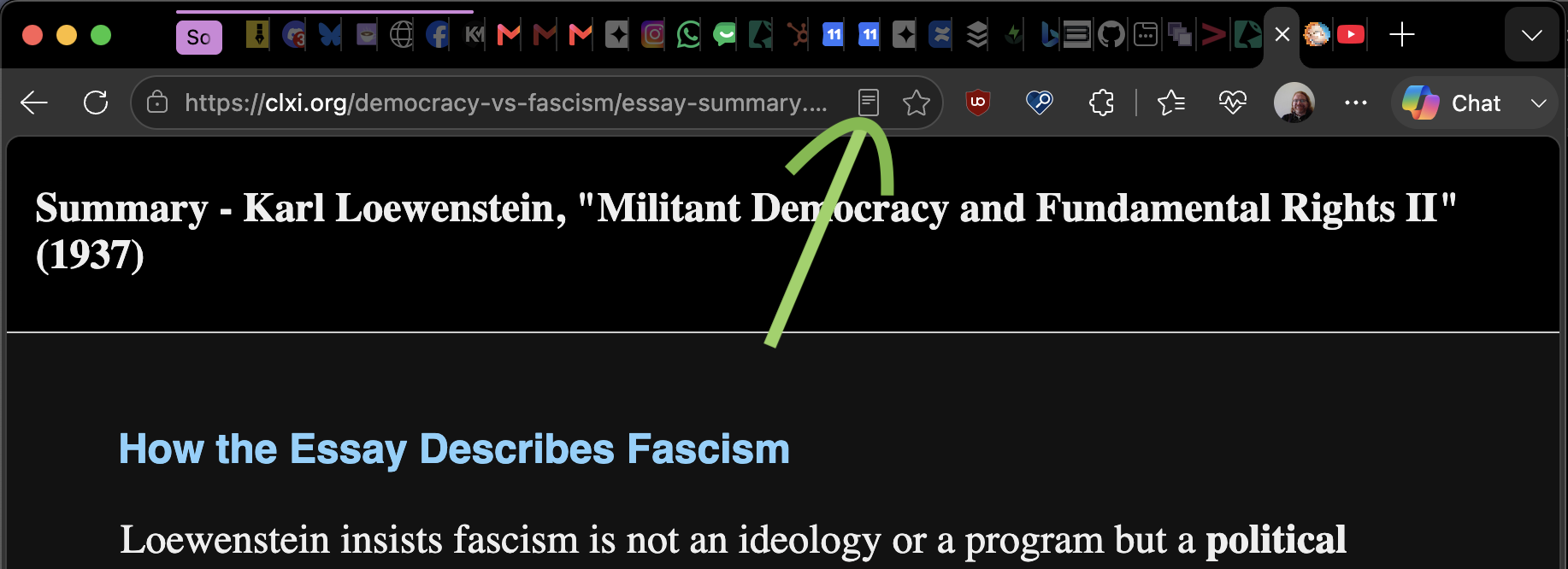
Once activated, you can pick another language from the translation menu:

The translation menu of the immersive reader

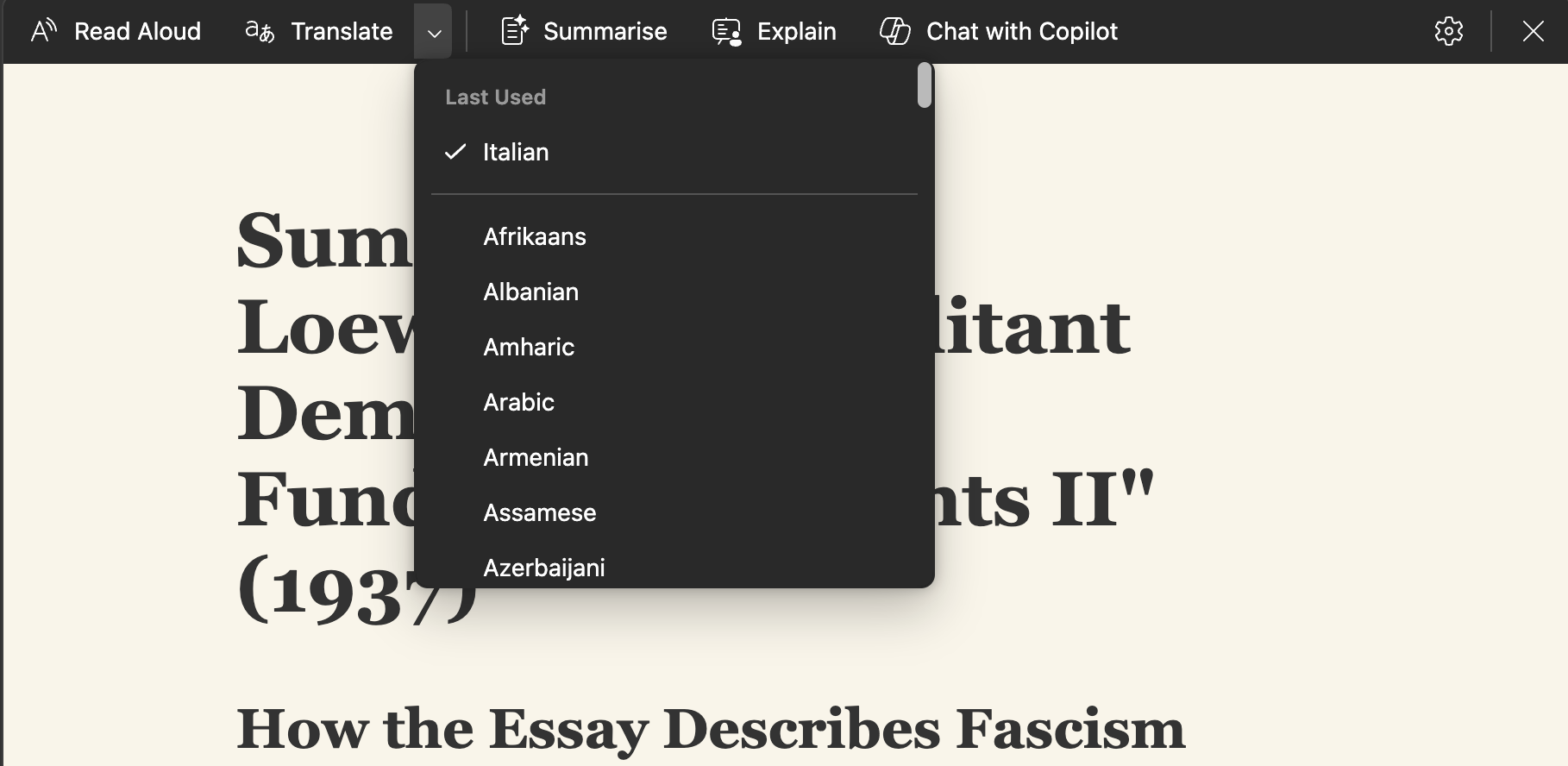
And the whole document will get translated for you to copy and paste.

The Document in Italian

You can see this in action in this video.

Anti-Social Media

Tuesday, August 11th, 2026

[prompt: create a viral hero image that shows what I mean. Or, don’t]

Currently I am on a half diet of social media as I am still locked out of X and by now I really don’t mind any more. Social media is dead and has been weaponised into a distraction, propaganda and rage discourse machine. I wished it weren’t that way, but we truly and thoroughly allowed the “social” web to become a dumpster fire that fuels hate, distrust and confusion. The goal is not shared experiences or creativity, the goal is to keep people glued to the screens and pissed off enough so they comment on other people being wrong on the internets using pre-made memes, AI slop and sound bites.

Mostly mainstream social media?

I am talking about the mainstream platforms here, Meta’s offerings (Facebook, Instagram, Threads) and X, but this downward spiral is also taking over BlueSky, LinkedIn and yes, even Mastodon. The biggest annoyance I see is that people don’t use the social platform to publish their thoughts, ideas and creativity, but instead create a persona of themselves that follows every silly rule the platform comes up with. The most grating part of this is posting about their work without including the link to it, but to add it in the first comment. This has been mandated by platforms to boost engagement over views, which is also the new metric that defines possible monetisation.

We’re not interacting socially, we hold the doors to lock people in

In other words, the platforms turned people into content creators and interaction baiters. There is nothing social about it, and you hardly see people even following a link let alone comment without redirecting to their work or disagreeing whilst spouting ready-made soundbites. The overall endgame seems to be for everybody to be an influencer. Guess what, if everybody is an influencer, nobody is…

And that’s not even the bots. Or, maybe they are, after all the human on social media is an endangered species. So, why bother at all?

Web2.0 was the start of the decline

I’ve been around when social media became a thing, when “web 2.0” was the new cool. I worked on things like Delicious, Flickr and posted tons on Twitter despite being wary of it from the get-go. I blogged long before and it felt weird to be limited to 140 characters. But it was cool that you could text Twitter (that died quickly). I loved that people got a simple way to publish on the web using Geocities, Neopets and the likes. I liked when people learned a bit of HTML by tweaking their Myspace profiles.

Early social media had an emotional core

I really enjoyed the first social networks that gathered people around something they can feel something about. With Flickr, it was photos, with LastFM, it was music. We used Upcoming to find events to meet people and we used b3ta.com and worth1000 to create horrible but funny and unique photoshop experiences. Specialist sites like Ravelry gathered millions of knitters and Etsy was a place for people to show and sell their craft (and boyfriends to suffer).

What it already had was lock-in

One thing that irked me about these things already back then though was that they locked people in. This, of course, makes it easier to grow and quality control a community, but it als means that if anything happens to the platform – like a sale to a larger corporation – all of it can be gone in a snap.

Who needs an emotional core when you can have UGC?

The real beginning of the end was when we stopped even caring about a central idea, or emotional heart, of the products. All-purpose platforms had nothing people can rally around, all they did was offer users to post whatever they wanted. It wasn’t about being a platform specialising in hosting a certain kind of content, companies didn’t even bother with a content plan, it was all about the UGC or “user generated content”. And constant and explosive growth.

When I worked on Yahoo Answers, the idea was to give human answers to problems people had, rather than algorithmic and SEO poisoned web results. Later on Quora and the unfortunately named Expertsexchange did similar things. This was good and we had wonderful stories where people found a special screw to fix their fridge there that saved them a $5,000 repair and similar random successes. Then the company stepped in and demanded much more growth and traffic, so we turned off the quality settings and allowed any old tosh to be asked and answered. The rest is history and a quick death of the platform. This is what happens to all of them now, it is a race to the bottom. Engagement trumps quality, baiting trumps thought.

Mainstream media never reports positively about social media

One thing I find fascinating is that main stream media never reports favourably about social media. Instead all the news reports are about battling addiction, misinformation and how social media hard-core addiction machines like TikTok rot the brains of our children. This could of course be seen as defending their turf, but I see it as a wake up call. Social media has become antisocial.

Specialist groups are still kind of a thing…

Thing is that within systems that are going down there are glimmers of hope. I gave up on the main thread in Facebook, but I do still have a lot of fun in specialist groups. In my case, 8 bit computing, BASIC programming, lots of dog stuff, vintage lego sets, Star Trek and filmmaking. It is a joy to see how all these groups take a special stand against AI generated content and remind people to just post because of the joy of it.

Yes, there’s always the fediverse…

Of course, there is always the indie web and fediverse movement to find joy in. It is frustrating to see though that everything federated and open seems harder to grasp for people and whilst I have tons of fun with people on Mastodon, it feels hard to share that joy to the mainstream. Maybe on purpose, but I think it is more about trying too hard to be open and independent which puts the onus on the end user to take part in it.

When you ask yourself “why am I doing this”, maybe stop doing it

I just finished a podcast and the guest, a CMO of a company explained that almost daily he finds himself thinking “why am I doing this?”. Why do we write blog post only for agents? Why do we comment and share things that are obviously created by AI? He also talked about the lack of joy and fulfilment he feels creating content that is 95% by Claude and optimised to go viral and 5% himself. We frustrate ourselves with efficiency maxing. Maybe social media should be an effort. Maybe we will get more out of it if we allow ourselves to be ourselves. Currently social media feels like being in a cover band and we’re so good in repeating the work and thoughts of others that nobody wants to hear or can even find what we want to say.
A blueprint for democracy to defend itself against fascism from 1937 – more important now than ever…

Tuesday, August 4th, 2026

In 1937, Karl Loewenstein, a German Lawyer published an essay in the American Political Science Review that can only be described as a blueprint for democracy to defend itself against fascism. You probably never heard of the essay entitled “Militant Democracy and Fundamental rights” and despite having a (highschool) degree in history, neither have I. And my topic of my final paper was the mistakes of Hindenburg that led to the rise of Hitler… Interestingly this paper was never translated into German. As we live in times that worry me, I thought it would be a good idea to convert the essay to markdown/HTML and translate it.

Give it a read, it is scarily modern and describes current happenings in worrying detail. The only difference is that with social media and AI, those who are against freedom, democracy and openness to the world have far better weapons than the Nazis had in the 1920s.

You can read the full essay and its follow up or stick with the summary. Here is a short gist of the learnings and definitions Loewenstein managed to distill quite nicely:

  • You can’t argue with fascists on the basis of facts – it is all about emotion
  • Fascists are incredibly good at blaming others and will repeat the same “big issues” caused by “those in power who abuse you” whenever they can
  • Fascism is not a national thing, it is a world-wide issue and needs collaboration across borders to repel

What is Fascism?

Loewenstein insists fascism is not an ideology or a program but a political technique for gaining and holding power. Unlike socialism or liberalism, it has no coherent philosophy or set of values behind it — its “programs” are invented after the fact to justify a seizure of power already underway. He calls it the “true child of the age of technical wonders and of the emotional masses”: a set of tools for arousing, directing, and exploiting mass emotion, deployed with calculated rationality by leaders who themselves remain unmoved by the emotions they manufacture in others.

How does Fascism succeed?

  1. Exploiting legality itself. Fascist parties operate openly and “legally,” using the very freedoms of speech, press, assembly, and parliamentary participation that democracy extends to all comers — treating democratic tolerance as a Trojan horse.
  2. Manufactured grievance and scapegoating. Vague, shifting complaints (corruption, chaos, national decline) are focused onto concrete targets — Jews, freemasons, bankers, chain stores — through relentless repetition, overstatement, and oversimplification.
  3. Paramilitary organization. A party militia forms, ostensibly for “self-protection,” but its real function is to intimidate the public, forge an unbreakable in-group loyalty that eventually exceeds loyalty to the state, and prepare a fighting force for an eventual coup.
  4. Publicity, not secrecy. Unlike older revolutionary movements, fascism thrives in the spotlight — constant self-advertisement and propaganda are the whole method, not a cover for conspiracy.
  5. Proportional representation and parliamentary immunity as tools. Fascists win seats and then use parliamentary privilege to attack the very institution that seats them, paralyzing normal governance until it appears unworkable.

What can we do against Fascism?

  1. Recognize fascism as a technique, not a legitimate ideology or ordinary party. Loewenstein argues the paralysis of Weimar came from treating fascism as just another political viewpoint entitled to full legal protection. Once democracies understand it instead as a hostile technique for destroying democracy from within, the response becomes conceivable.
  2. Pass targeted anti-fascist legislation aimed at the specific techniques, not general ideas. He points to actual measures adopted by democracies of his day: banning political uniforms and party militias, restricting the use of parliamentary immunity to sabotage parliament, curbing incendiary propaganda, and requiring paramilitary-style organizations to register their bylaws with authorities.
  3. Restrict or eliminate proportional representation where it hands legislative footholds to anti-democratic parties. He singles this out as “that gravest mistake of democratic ideology” because it lets small extremist minorities gain an outsized platform inside the very institutions they intend to destroy.
  4. Refuse to let democratic tolerance extend to parties that deny democracy’s own rules. The essay argues that formal equality before the law should not mean fascist and democratic parties get treated identically when one openly seeks to abolish the system granting it standing.
  5. Suppress party militias and paramilitary symbolism before they mature into a rival armed force. Loewenstein treats this as one of the most urgent fronts, since an unchecked party militia becomes the instrument of an eventual coup.
  6. Act early, not reactively. The German illustration is presented explicitly as a warning: half-measures, delayed bans, and reluctance to enforce laws already on the books let the movement outgrow the point where ordinary legislative correction still worked.
  7. Pursue international cooperation among democracies, which he criticises as badly lacking in 1937 — currency and trade agreements among democratic states were treated as narrowly economic rather than as part of a shared defence against a transnational fascist movement that was, by contrast, coordinating closely across borders (Berlin and Rome supporting fascist movements elsewhere).

When I look around social media and election posters, I worry. You should, too. Take a look at the programs of some of the parties people insist on voting for to “get some change” and “show the lazy politicians who is boss”. If their party program includes separating from other countries and border-crossing institutions, that’s a red flag. If they keep blaming one thing that came from outside your country on all that is wrong and sell themselves as the only ones who will do something about it, that’s another red flag. If parts of their political program actively violate current law in your country or of the group it is part of, that’s a proper no.

The rise of fascism in the 20s and 30s lead to one of the worst wars and unspeakable crimes against humanity. Never again, we should be much, much more intelligent and open eyed than back then. Alas, I don’t see that happening.